Friday, March 17, 2017

The South of Michigan

Image result for dive bar

        Detroit. James Jameson didn’t need a metaphor to describe how he felt about Detroit. The city’s name carried a connotation that said it all. That’s why he chose his latest novel to be set here. The city itself was a metaphor; for something that was happening on a grander scale across the nation. It was the perfect setting for his literary masterpiece. He just never thought that the citizens of Detroit would embrace such a novel. Didn’t they realize he was mocking them? And since when did people in Detroit read literature?
        Now, as he trampled through the sidewalk’s dirty snow, he felt trapped in this rust belt city. Where were the trains? The buses? The taxis? Any transportation to get him to the airport; to take him away from this godforsaken city? He regretted coming in the first place. But that was part of the job, wasn’t it? To travel to your audience, to read your words aloud for their simple ears, to convince them that your story is worth their hard earned pay? But why did he choose Detroit? Why not the South of France? And now, what the hell was this?
         James stared at the bar in disbelief. The Motown Tavern. But it couldn’t be. He was always meticulously careful not to use real establishments in his stories. But even the sign on the window was the same: “If the Doors Unlocked, we’re Open.” Son of a bitch, he thought, they stole this straight out of my book. This meant they were using his ideas for their profit, which surely meant a lawsuit. He pushed the door. It was unlocked.

            “Whatchya drink?” the bartender asked.
            “Excuse me?” James eyes widened.
            “This is a bar. People come here to drink booze. What kinda booze you want?”
            It couldn’t be. Could it? The bartender looked exactly like the main character in his novel, right down to the suspenders and sideburns. He even talked the same. “Is this a joke?” James asked.
            “Is what a joke?”
            James half laughed to himself. “Tell me, what’s your name?”
            “Names Martin, friends call me Chops. Who’s askin’?”
            “All right,” James said, so everyone in the room could hear. “Where are the cameras?”
            “Cameras? Watchya talkin’ ‘bout, cameras?”
            “Now, you listen here,” James pointed at the man behind the bar. “I don’t want to be on some idiotic reality television show…”
            “Television show? What da hell you talkin’ ‘bout?”
            “Listen, we both know who I am.”
            “Oh yeah. And who’s that?”
            “James Jameson. The Author. I created your character.”
            “My character?” The bartender yelled. “Now you better watch your…”
            “Hey!” A voice echoed from the end of the bar. “Both of you, quiet down.” The young, handsome man looked at James. “What did you say your name was?”
            “James Jameson.”
            “That’s impossible.”
            “And why is that?”
            “Because James Jameson is a character I created for a short story; an author, in Detroit for a book reading…”


Friday, March 10, 2017

Ups and Downs

  Related image          


            In 1923 the British mountaineer George Leigh Mallory attempted to be the first man to climb Mount Everest. When asked why, he replied, “Because it’s there.” His body was not recovered until 1999.
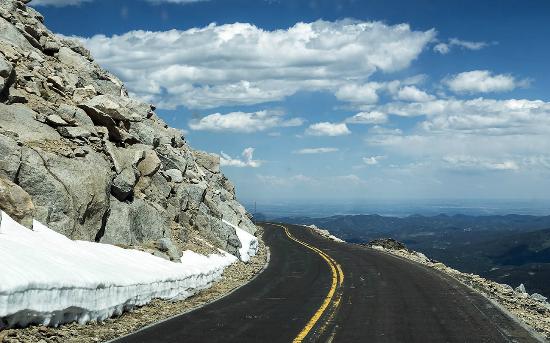
            Looking west from Denver, on a clear day, among the Rocky Mountains, you can spot a peak that is uniquely different than (FROM) any of the others. Though you could never tell from that far away, there is a road that cuts up the mountain, twisting and turning until it reaches the summit. And when I was told that it was the highest paved road in North America, I had but one thing on my mind: conquering Mount Evans.
            I had already ridden my bicycle from the Atlantic Ocean, half way across the United States. After a week of much needed rest, I was ready to go. Targeting the Pacific coast, the mountain was a bit out of my way, but I was convinced that a two day detour would be well worth the trip. I had no way to know the next time I would be in the region, if ever again, and could not pass up the opportunity.
            I got a late start on a Tuesday. Battling Denver’s mid-morning traffic, I was nearly clipped by an elderly woman in an oversized car, but thankfully made it out of the city alive. When I reached the mountains I traded exhaust fumes for a steep incline, a deal that I would take any day. It felt good to be back on the bike, away from the crowds, only myself, my thoughts, and the open road.
            I worked my way up the mountain. Normally I would not refer to riding a bicycle as “work,” but after hours of nonstop pedaling, in the lowest of gears, I am willing to make an exception. Often times mountain roads never seem to end. They play with your mind, convincing you that every next turn will be the last, but the only things that lay ahead are more gradual inclines and a steady dose of disappointment. So you rest when you need to, and you ride on.
            I reached the Mount Evans Scenic Byway just as the sun was fading, giving way to a chilly night. I had traveled approximately fifty miles, almost entirely uphill, and my body could feel the effects of elevation change. Mount Mitchell, in North Carolina, at 6,684 feet, was the highest I had ever been in my life. Now, at nearly twice that height, I could clearly notice the thinness in the air. My lungs were not getting the oxygen they craved, and the pressure in my skull had evolved into a mild ache. I found a flat spot in the woods, rolled out my sleeping bag, and closed my eyes.
            As exhausted as I was, rest should have come naturally, but it didn’t. I would sleep for what felt like ten minutes at a time, then wake up, spend the next half-hour shuffling around, trying desperately to fall back into my dreams. Finally, at around four in the morning, I called it quits, packed my saddlebags, ate some breakfast, and started for the summit.
            From the start of the byway it was fourteen miles to the top. I had been averaging just under that per hour, but almost always on flatter terrain, and never at that elevation. I pedaled in the stillness of the morning, the chilled mountain air punishing my lungs, the pressure in my head evolving, and my stomach growling. I stopped often to munch on snacks and to try to catch my breath. I passed mile marker four as the sun lit up the sky, and the realization set in that I was making little progress.
            Eventually the tree line disappeared, leaving only large jagged rocks, enormous patches of snow, and the playful wanderings of  mountain goats. It was the first snow I had seen since New York, and the first mountain goat I had seen in my life. I stopped to watch the agile animal gracefully shuffle across the scattered rocks, not a care in the world. This was his home, and I was merely a tourist.
            By mile ten I could not get enough food in my stomach and felt sick. My energy running low, I was now walking the bike more than riding. The weakness that consumed my body was all new to me. I was in the best shape of my life, but felt worn down, any remaining strength drained, my head pounding. It was equivalent to the worse of hangovers. I wondered if this was what terminally ill patients felt like all the time. In the gloom of the situation, I had never been so thankful for my health. Stubborn, I pushed on.
            The higher the road winded, the worse its condition. But the potholes and cracks did not matter, because I was almost entirely on my feet, drooped over the handlebars, leaning uphill. For every hundred yards that I rode, I walked twice the distance. And when I finally reached the summit, climbing back on the bike for the last hundred meters, an overjoyed sense of relief filled my soul. I had conquered Mount Evans, the highest paved road in North America. Well, not quite yet.
            The mountain is listed as 14,264 feet high, but the end of the road falls about fifty meters short of that. So I leaned my bike against a railing and headed up the rocky terrain on foot. Already disoriented, I didn’t realize that there was a trail, and climbed straight up the jagged boulders, scaring yellow belly marmots along the way. I climbed to the highest rock on the pile, and finally at the top, spread my arms open and embraced the crisp Rocky Mountain wind. It was that corny scene, straight out of every sentimental movie, but it didn’t matter, there was no embarrassment, for there was no audience.
            Savoring the view of the Rockies from above, time could have just as well stopped. It was a clear morning and the sister mountains could be seen in all directions: Pikes Peak to the north, Goliath Peak to the west, Roger Peak to the South, and dozens of others scattered among the rest. It seemed as if the land would not settle for flatness, and sought nothing less than the clouds. It was how I pictured heaven.
            I leaned against a rock to peek over the edge and it shifted, sending shivers of fright up my spine. It was time to return to flat ground. As I made my way back down to the road I spotted another cyclist approaching the summit. As soon as he reached the end of the road he turned around and headed back down, never once getting off his bicycle seat. I was confused. How could somebody work so hard to get to the top, and not even pause to take a look around? Just like every typical American, always in a hurry.
            Upon returning to the pavement the realization occurred that I was suffering from altitude sickness. I knew this because a large sign told me so. “ATTENTION,” it warned, “REGARDLESS OF FITNESS LEVEL, ‘LIGHTHEADEDNESS’ AND DISORIENTATION OFTEN OCCUR AT THIS ELEVATION. YOU MAY FAINT OR UNDERESTIMATE OTHER DANGERS. IF YOU EXPERIENCE ANY OF THESE SYMPTOMS AVOID PHYSICAL EXERTION. EXERCISING CAUTION, RETURN TO LOWER ELEVATION.” I disregarded the sign, its advice, and my general well-being. I had worked too hard to get where I was and was not about to leave just yet.
            The parking lot was filling fast, mostly photographers in search of that perfect shot. I used the outhouse, not that I really had to go, but rather to bask in the absurdity of there being a bathroom at fourteen hundred feet. On the west side of the summit stood an old rock foundation, its walls jutting out of the ground, open and exposed, like a scene straight out of Middle-Earth.
            Trying to keep my footing on its icy back staircase, I was halted by a mountain goat that stood firm in my path. He stared back at me, the invader that was trespassing in his castle. But already having traveled this far, I refused to retreat. It would be a standoff, a classic man versus mountain goat standoff. He knew his place and I knew mine, but neither of us were willing to give in. I took a deep breath and stepped forward. He did the same. I flinched at the beast but he was not startled. He bowed his long face to show off his pointed horns, but I was unafraid. I took another step, then another, until he was close enough to reach out and grab. I stared directly into the blackness of his eyes and for a moment could see what he was thinking. And at that second the realization occurred: antagonizing a wild animal was probably not the best of ideas.
            Acting purely on instinct, a beat away from panic, I hoisted myself upon the stone wall that stood to my left. Maybe this spooked the goat, or perhaps we were on the same mental wavelength, but he retreated as well, hightailing it through an opening, out of the castle, and down the mountainside. In spite of my cowardice, I claimed victory, but the celebration was short lived. On the other side of the wall, now all staring up at me, stood half a dozen photographers who were the least bit amused with my widening smile. I had just ruined their perfect shot.
            Behind the expensive cameras, mounted on their aluminum tripods, I could clearly see the disappointment and anger in their faces. But I was not the least bit sorry. There would be other photo opportunities, if not in the next five minutes, then later in the day. But as for me, that was probably my only break, a once in a life time chance, to win a standoff with a mountain goat. I took one last look around and decided that it was time to get off the mountain.
            I was more than excited for the descent.  Most people may not know this, but the primary reason bicyclists go through the agony of climbing hills and mountains is because it is guaranteed that they will eventually get to ride back down. There are few feelings in the world that are more exhilarating. Unfortunately this time it was different. The air being thin, the wind gusting, and the road steep, combined to send a bitter chill through my entire body. Even with mittens on my hands, my fingers went numb. Squeezing both breaks with all of might couldn’t smooth the fractured pavement. The ride was shakier than the nastiest of wooden roller coasters. I thought for certain that I would pop a tire or blow a spoke. And often with a deathly high drop to my right, one mistake would have proven disastrous.
            I passed a biker who was struggling to make it to the top. Then another, and another. The lower I got, the more I passed, until the number reached the dozens. These were not casual weekend riders. They were focused, with super light weight bicycles and full spandex outfits. I couldn’t believe that many people were attacking the mountain on a random Wednesday in June.
            When I reached the end of the Mount Evans Scenic Byway there were dozens more cyclists in the parking lot, preparing themselves for the journey ahead. It was eleven in the morning. What had taken me six hours to ascend had taken me less than an hour to get back down. I went into the lodge to get some much needed food and hopefully some information. The restaurant’s menu offered a wide variety of items but it was the Mountain Man Burger that stuck out. After dieting on cheeseburgers for what seemed like too long, it was the last thing I craved, but with a name like that I had little choice but to order it.
            From an old newspaper article that hung framed on the wall I found out that the rock foundation at the summit had once been a restaurant and gift shop that was completed in 1942. Formally called The Crest House, it was destroyed on Labor Day, 1979 when a propane tank exploded. A restaurant on top of a mountain is a picture in itself, but a restaurant on top of a mountain blowing up, that is something that I would like to have seen. And though I could have desperately used some warm food and a place to sit down upon reaching the summit, I believe a mountain goat castle was more than a fair trade.
            Another clipping on the wall described the paved mountain road as the highest in the world. I hade to take a second look, for I had been told that it was only the second highest. When the waitress brought me my food I asked her about it.
            “Technically,” she said, “there is a mountain in Peru that claims to have the highest road. But my boss was there earlier this month and said that it was in horrible condition.”
            “So as far as bicycling goes…”
            “A lot of people would consider this the highest in the world,” she interrupted, “but it all depends on who you ask.”
            The response lifted me up, because in my mind I had reached the top of the world. But the answer to my next question brought me right back down. “Are there always this many cyclists attempting to summit?”
            “Oh yeah, everyday, all summer. More in July and August, and even more on the weekends.”
            What I thought had been a grand accomplishment was something that thousands of people did every year. I was just another cyclist, completing another weekday ride. I ate my burger, bought some postcards, a sticker to add to my bike, and left the lodge. Outside a couple of other cyclists were standing next to my bike, looking at the stickers of the places I had already been. “You going cross country?” One of them asked when I approached.
            “Trying to.” I answered.
            “Well, it looks like you’ve made it pretty far already.”
            “I still have a long way to go.”
            “Are you going to try to make it up this mountain?”
            “I was already up it this morning.”
            They looked at their watches. “And you’re already back down?”
            “I got an early start.”
            “You didn’t ride up with all this weight on the back, did you?” Referring to my saddlebags filled with gear.
            “Yeah, I did.”
            “Wow, I am impressed. We drove up from Denver this morning. Made it about halfway up the mountain and couldn’t do it. Had to come back down.”
            As they wished me luck and walked away, my attitude completely changed. Here were two guys that drove to the start of the byway, and still could not make it up the mountain. Their bikes alone were each worth five times as much as mine, and yet they were impressed with me. I mean, who really cares how many people ride to the summit everyday? I know that I did it, and that is the only thing that really matters to me. It was a truly personal experience, one that I will never forget.
            Looking back I can honestly say that summiting Mount Evans on a bicycle was one of the hardest things I have ever done in my life. So why did I do it? Because it was there. And would I do it again? In a  heartbeat.


Friday, March 3, 2017

The Mandela Effect

In the early 1990’s the comedian/actor Sinbad starred in a movie titled Shazaam. The family-film, in which Sinbad played a genie who finds himself the servant of an upper-middle class family, wasn’t a box office smash by any means, but it did build a small cult-following when it was released on VHS. Many children who grew up in that era, who are now adults, have fond memories of the film. Some can describe specific scenes—a pool party climax, for instance—while others can recite lines from the film, word for word. There’s only one problem: The movie doesn’t exist. And Sinbad claims he never made it.

So, how does this happen? How can so many people have a specific memory that doesn’t exist? This phenomenon of collective false-memory has been dubbed the Mandela Effect. Nelson Mandela died in 2013, and yet there are thousands of people throughout the world who specifically recall watching his televised funeral in the 1980’s. Another commonly reported false-memory is that of the Berenstain Bears. Or, as, again, what thousands of people claim, was once spelled the Bernstein Bears. (Interestingly enough, my computer’s spell check recognizes Bernstein, but not Berenstain.) So, again, how can so many people have the same false-memory?

Of course, there are rational explanations for a phenomenon like this, but that’s no fun. I’d rather talk about an irrational explanation—something paranormal theorists refer to as “alternate timelines.” Think about it for a minute. What if there are numerous dimensions? And sometimes we, as individuals, split off and travel down a different timeline than others. I know exactly what you’re thinking right now: This guy is bat shit crazy. But then again, you’re still reading, so you must be at least somewhat curious. And I’ll admit, this theory does sound crazy at first, but is it anymore crazy than believing that there is an invisible all-knowing entity looking down us and judging our every decision? If that wasn’t something engrained into your mind since a young age, I’d be willing to bet you might think that’s as equally crazy as alternate timelines.

So, this alternate timeline idea, I’ll admit, when I first heard about it, I thought it was, well, for lack of a better term, bat-shit crazy. But recent events have got me really thinking about it. You see, there was a time in my life when an expected outcome of an event resulted in that expected outcome. But then, sometime about a year ago, all of these expectations—no matter how educated the guess appeared to be—suddenly began to become meaningless. In retrospect, I suppose it started with the NBA playoffs. Oklahoma City had a demanding 3-1 series lead over Golden State. And then, against all odds, they blew it. In the finals, Golden State suffered the same exact fate against Cleveland. Fast forward to the World Series. Same thing—the Cleveland Indians blow an unprecedented 3-1 lead. A week later, the Presidential Election. There was no possible way Trump could win. We all know how that turned out. Super Bowl—28-3 lead in the third quarter. Blown! And now, the Oscars—the Best Picture goes to La La Land! But hold on just a second…

I feel like I’ve entered this strange timeline where all expected results never end up quite how I imagined they would. It’s almost as if everything suddenly needs to come right down to the wire. Everything needs to be packed with an exciting twist that nobody saw coming. As if M. Night Shyamalan is scripting our reality. Now, I’m only 34 years old, but for the first 33 years of my life, if a football team had a 28-3 lead in the third quarter, that team won the game. And if a film was handed a trophy, they got to take that trophy home with them. I don’t know exactly what’s been going on lately, but if these athletes and entertainers are going to stand up after these events and give credit for these unexpected outcomes to an invisible entity in the clouds, then I’m at least going to consider the possibility that I’ve somehow skipped over to a timeline alternate to the one I had been previously living in. Call me bat-shit crazy, but the more I really think about it, the more I begin to remember that Sinbad genie movie. 


Saturday, February 25, 2017

Five Hundred Words


           Five hundred words? How can I possibly write a coherent story in five hundred words (or less)? That’s so few words; and like a fool, I’ve just wasted thirty-one of them. You see, there’s this contest. They’ve given me a plot. Now, I only need to use it. But here I sit, in front of my keyboard, with a case of writer’s block that I wouldn’t wish on my worst enemy, writing alliterative cliché’s that I know I’m better than. And now I only have four hundred and four more words to develop character and setting. Staring at this paragraph doesn’t seem to be helping. Perhaps I need to get out of the house. Perhaps I need to quit wasting words with unnecessary words like “unnecessary” and “perhaps.”
            I take the bus downtown, to the market, with the idea that getting lost in a crowd might somehow spark my creativity, might help to find my story. By the time I get there, I’m down to three hundred and thirty words. I’m walking around, proceeding about my business eyeballing trinkets and ignoring buskers, all the while waiting on a strange person to thrust a mysterious object into my hand. I know this will happen because that’s the plot that’s been decided upon in advance. And then it happens. With two hundred and seventy-eight words to go, I’m caught in a crowd, confronted suddenly by a strange person, who thrusts a mysterious object into my hand, and without a word, disappears. The mysterious object, “What is it?” you want to know. It’s an envelope, sealed, with a handful of words written on one side: “Don’t open until you get home.”
            So, I start for home, making my way out of the crowd, away from the market, towards the bus stop. I check the schedule: no bus for an hour. With only one hundred and eighty-seven words left, I don’t have time to wait. And so I run, down First Avenue, a right on Belmont, over the Morrison Bridge, east towards home. The envelope weighs heavy on my mind: What could possibly be in it? Why do I have to wait until I get home to open it? What would happen if I didn’t? I consider opening it right here and now, but with only one hundred and fifteen words left, I don’t dare chance it.
            My muscles ache, I’m drenched in sweat, and with only a mile to go, I’m stopped by someone I know. “What’s the hurry?” she asks.
            “No time to talk,” I yell in full stride, “I don’t have enough words left for you.”
            I know it was rude, but what can you do when you’re on a budget? I reach my house, unlock the door, rush to my desk, and go to open the envelope with thirty-one words to spare. I tear it apart and look inside, and there it is, exactly what I knew it would be: the end of this story, because I’m out of words…


Friday, February 17, 2017

The Return of This Digital Life


Five days without my smartphone or the internet and the world did not end. Go figure. When I returned on the sixth day, I was so overwhelmed by notifications, emails, and messages that I decided to stay away for one more day. But now I’m back. Here’s what I learned:

#1) Whether you like it or not, your digital life will go on without you. Even though I was detached from social media, social media was not detached from me. Since I was away with friends—friends with smartphones of their own—new photos of me found their way onto the internet. I was “tagged” and they were “liked”, all without my consent, as if anyone in your vicinity with a smartphone has become part of your own personal Paparazzi. But that’s not all. Even those who were hundreds, sometimes thousands of miles away, continued to interact with my digital life even though they knew I wouldn’t respond. Some tagged me in Facebook posts. Others commented on old posts. New posts were pasted on my wall. I was sent text messages and emails. Interestingly, I had no missed calls, as if people feel comfortable digitally contacting a “ghost”, but not personally. (p.s. I apologize for not “liking” or replying to the posts, comments, etc., that I was tagged in while on my digital vacation, but with the current real-time pace of social media, I’m not sure what the proper protocol is concerning days-old posts.)

#2) It’s perfectly okay to not take photos of everything you do. I traveled to a small town in Washington that is modeled after a Bavarian Village. Simply put, it is a photographer’s wet dream. Luckily, there were thousands of other “photographers” there, all taking the same pictures I would have taken (probably not as good as the ones I would have taken, but nonetheless). Plus, if I really need a photo to remember the trip, my beautiful girlfriend took about seven thousand of her own. And like the old saying says: “A photo might be worth a thousand words, but your memories are worth a thousand photos.” (I may have just made that up.)

#3) Few people actually make it past the first couple sentences of anything posted on the internet. I know this to be true from the comments I received last week when I wrote about how I was leaving for a digital vacation. Several people thought I was leaving my digital life for good even though I clearly stated that my exit was only temporary. Apparently, people only care to read headlines these days, which explains so much about our current political situation. It also means I can write whatever bat-shit crazy thing I want right now and be confident that not many people will actually read it. Which brings us to:

#4) My digital vacation was extremely refreshing, like taking an ice-cold shower or running naked through a snowstorm. I highly recommend the next time you travel away from your safe space for an extended period of time, leave all your digital devices at home. I promise that the world won’t end, and if you’re lucky, you’ll find greater appreciation in your actual life—you know, the one away from the screen.


Bonus: If a photo is worth a thousand words, and this piece is about 500, does that mean it’s worth half a photo? 


Friday, February 10, 2017

This Digital Life

I’m going on a digital vacation. I’m traveling hundreds of miles away from my safe space and leaving my phone and computer at home. I know what you’re thinking: That’s crazy! I know you’re thinking this because when I told people about this idea they all replied (in so many words): That’s crazy!

Actually, there were two reactions. There was: What if there’s an emergency? In which I replied: You do realize there was a time before Smartphones? A time called: All of human existence. Seriously, what if there’s an emergency? What did people do before Smartphones when there was an emergency? They dealt with it, that’s what they did. Plus, we do live in a digital world now. Certainly, in the case of an actual emergency, there will be people in the vicinity that have a Smartphone of their own. It’s not like I’m vacationing in Antarctica.

The second response was: How are you going to take pictures. Simple: I’m not going to. It turns out, you don’t have to take pictures of everything you do.

A short digital biography: My digital life was born three years ago. It started with a simple website, an unusual blog, and my entry into the world of Facebook. I didn’t go through digital puberty until October of 2016. That’s when I got my first Smartphone. In only four months I’ve become fixated on Instagram, Insta-news, podcasts, the stock market, and Tetris—all things that I never thought about before the Smartphone. Only four long months and I already feel it’s time for a digital vacation.

After some consideration, I’ve come to realize that this digital vacation can end in only three ways:

A) When I return, the Internet will no longer exist, which will affect everyone, but also means I’m a trendsetter.

B) My digital death. This means that I come to the conclusion that my digital-life is not worth my actual real-life time. Due to the psychological addiction of Smartphones, this will certainly become a thing in the near future. We will see the digital deaths of our friends, which is sad, because many of my closest friends are in the digital world. If I don’t come back, I would only hope that my digital friends give me the first ever digital funeral.

C) I return to my digital life and tell everyone all about my digital vacation. If that’s the outcome, I’ll see you next week…digitally, of course.


Friday, February 3, 2017

The Last of the Hard Men


               I needed out of the city. I needed to get away from that urban lifestyle which seemed obsessed with cool clothes, hip hairdos, stylish staches, multi-flavored macchiatos, soymilk smoothies, yuppie yoga, or whatever else was trendy at the time. I longed for proof that hard men still existed. The kind I had seen in the movies when I was a kid. The kind filled with courage, honor, nerve, and grit.
            So I headed away from the city, through the suburbs, past the small towns, deep into the wilderness, until I found a random tavern, a one-room shack whose sign simply said: BAR. I parked my bike, walked inside, ordered a beer, and waited.
            It didn’t take long before he walked in. He was everything I dreamed he would be. I studied him carefully. He was tall and muscular, with a jaw line right out of a John Wayne movie. He wore an old cowboy hat, flannel shirt, leather jacket, ripped jeans, and work boots, all of it filthy. His eyes were cold, his beard thick, and his face tanned like a catcher’s mitt. He had a scar running across his brow, a couple chipped teeth, and fingers missing from both hands. When he ordered his drink, he only needed to growl one word: WHISKEY.
            There he was, right in front of my eyes, close enough that I could smell pine tar on his hands and the tobacco in his lip. I wanted to touch him, to make sure he was real, but the bowie knife that hung from his belt and the pistol hugging his ankle were clear signs not to get too close.
            So I just stared, carefully examining the proof that sat next to me. The proof that courage, honor, nerve, and grit were not virtues of the past! The proof that there was at least one last hard man left on Earth…and then he pulled out a Smartphone and started playing Candy Crush.