Tuesday, June 24, 2014

Getting Fixed

Don’t stop! Whatever you do, don’t stop pedaling. Wow, déjà vu. The last time I started a story with those two sentences I was riding a bike up the steepest hill in Portland, Oregon (see: “The Reasons We Ride the Ronde,” April 7, 2014). This time, I’m doing almost the exact opposite—instead of climbing up, I’m flying down. Though the hill I’m currently bombing is far from the steepest in the city, it is drastically more dangerous. If I were to stop pedaling right now, I would most likely be thrown over the handlebars of my bike, much in the same way cowboys are bucked off those massive bulls that they attempt to ride for eight seconds.  On the bright side, I wouldn’t have a giant animal bearing down on me immediately afterward, but on the not so bright side, instead of landing in dirt, I would most likely slide across rough pavement, leaving the road with a thin coating of my skin, and embedding my now-exposed flesh with a mixture of asphalt and whatever other debris happens to be on the ground. And that’s why I don’t stop pedaling.
            I’m riding in the fixed-gear category of the Mount Tabor Series, a six-week long road cycling event sponsored by River City Bicycles. Every Wednesday night, I and about ten other participants, test our skills around the 1.3 mile loop that circles the park’s upper reservoir. To a non-cyclist the course may seem relatively easy—one and a third miles around an artificial body of water. What’s the big deal? And if the course were flat, it wouldn’t be that big of a deal, but this course is anything but flat. In fact, of the 1.3 miles, I would estimate that less than 200 yards of it is on level ground (perhaps the “Mount” in Mount Tabor gave that away). For the remainder of the race you’re either going up, or you’re going down. And normally, the going down part would be a welcomed break—time to rest your legs—but when you’re on a bicycle with a fixed gear, the downhill suddenly becomes the hard part.
           
Unlike most modern bikes, a fixed-gear bicycle, or a “fixie,” as they’re also known, has its cog connected, or “fixed,” directly to the hub of the back wheel. Whenever the rear wheel is turning, the chain moves with it, therefore forcing the front chain ring, and the pedals to turn as well. In laymen’s terms: if the bike is moving, so are your legs. Primarily intended for track racing and trick riding (fixies allow riders to power their bike in reverse), the fixed-gear bicycle has gained somewhat of a cult status over the past few decades, becoming the two-wheeler of choice for many urban hipsters, bicycle messengers, and bike polo competitors (bike polo is almost exactly what it sounds like—polo on bicycles instead of horses).  While fixies might very well offer an advantage for track racers, trick riders, and polo players, it is hard to believe that messengers and hipsters ride them for any other reason than the “cool” factor, or because they simply find the experience fun. People will argue that fixed-gear bicycles are cheaper, lighter, and easier to work on, but then again, people will argue about most anything. The truth is that a single-speed bike with a freewheel (the opposite of a fixed-gear, in which the rear wheel moves independently from the pedal, as on most modern bikes) is relatively similar to a fixie in all those categories, along with being much safer.
            I’m not a bike messenger, or a trick rider, or a polo player. And though I may be a hipster (see: “An Accidental Hipster,” April 23, 2014), I certainly don’t ride a fixie because I think it’s “cool.” I ride a fixie because it’s free. I know that sounds like an oxymoron—riding something that’s fixed because it’s free—but hear me out. The Mount Tabor Series is one of the only bicycle races in Oregon that offers a fixed-gear category and if you sign up for any another category, you are eligible to compete in the fixed-gear race free of charge. The words “free” and “race” hardly ever go together, so, naturally, I jumped at the opportunity to get some extra “warm-up” laps in without having to pay for them. One would think that more people would find the offer enticing, though of the 200-plus competitors each week, only three of us choose to race in both the fixed-gear and our respective categories. This could be because it requires bringing two bicycles to the venue (I live close enough that I can make it home between my races to switch out bikes), but I believe the real reason is something else all together—it’s extremely hard; perhaps the most challenging race of the night. So difficult in fact, that the champion of the Pro Men’s category during the first three races of the series has failed to win the fixed-gear race two of those weeks, coming in a close second on both occasions.
            Personally, I'm not here to win the race, or even podium for that matter. I'm simply here to survive, and hopefully become a stronger rider in the process. The most interesting thing I find concerning the Mount Tabor fixed-gear race is that the uphill is the easy part. Well, maybe “easy” isn’t the best word for it, but it’s definitely “easier” as far as I’m concerned. Climbing the approximately 138 feet of elevation simply requires you to stand up out of your saddle and drive your legs into the ground like a pair of pistons, slow and steady, until you reach the apex of the hill. It’s the 138 feet of downhill that I find most testing. Normally, on a downhill ascent, you just let gravity take over and pedal if you please—a great opportunity to give your legs a rest. But when you’re riding a fixed-gear bicycle, the faster the bike gets going, the faster your legs are forced to spin, and if you’re not accustomed to your legs spinning at incredible speeds, the experience can seem very intimidating. And unless you like the burn that’s associated with pouring hydrogen peroxide over open wounds, that’s when you have to remind yourself: Don’t stop! Whatever you do, don’t stop pedaling.

Tuesday, June 17, 2014

The jonpenfold.com Summer Burpee Challenge

Challenge (n) : a call or summons to engage in any contest, as of skill, strength, etc.
Burpee (n) : a full body exercise used in strength training and as an aerobic exercise
Summer (n) : the season between spring and autumn
jonpenfold.com (n) : the most interesting blog on the Internet
The jonpenfold.com Summer Burpee Challenge: How fast can you do 100 burpees?

Last year I did 50,000 pushups. I’m not here to brag about the accomplishment. For one thing, I didn’t really do it for anybody but myself, as I’ve hardly ever mentioned the feat to others until now. For another thing, I’m not really sure if I actually did 50,000, as I found myself quite lazy during the weeks between Thanksgiving and Christmas. But If I didn’t reach my intended goal, then I came damn close. I got the idea for the 2013 Pushup Challenge as I was watching the news one night and saw a story about Sergeant Enrique Trevino, a United States Marine who in 2012 did a million pushups over the course of the year. If he could do a million, I figured, I could certainly do 50,000.
           And so I did pushups—usually 200 a day, five days a week. I would do sets of 50, some in the morning, some at night, while sneaking others in during work hours (it sure feels good to do pushups while on the clock). And I’m not going to sugarcoat it—it wasn’t easy. But it made me feel healthier, stronger, and more confident than before I began doing the pushups. At certain points during the year, I even thought it would become a lifelong routine. I assumed that I would continue to do 50,000 pushups every year for the rest of my life, or at least until I reached the age of 200. But then Thanksgiving came, with all that great food, and then Christmas, with even more great food, and then New Years, with all that great alcohol, and the pushups stopped. So far, this year, I bet I’ve done less than a thousand. And I know this may sound strange, but I miss doing pushups.
   
So, with summer starting this weekend (Saturday, June 21st) I have devised a new challenge—The jonpenfold.com Summer Burpee Challenge! It’s quite simple: How fast can you do 100 burpees? Get a stop watch, press start, do 100 burpees, press stop, and record your time. Pretty easy. Well, maybe “easy” isn’t the best word to describe it. Anyway, that’s all there is to it. By the end of the summer, whoever posts the fastest time wins. And don’t get me wrong, I DO NOT intend on this being a contest, it’s just that for some people, a little friendly competition can translate into a great deal of motivation.
           
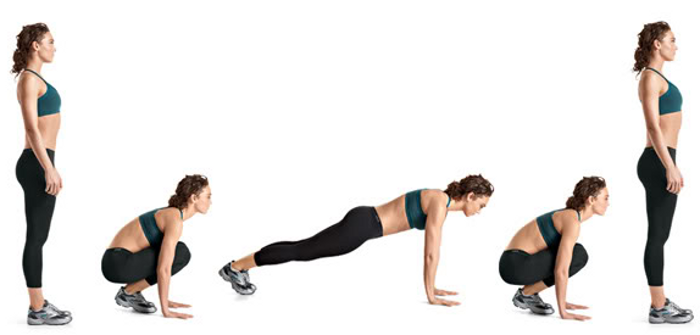
First thing first—let’s talk burpees. The exercise was named after Royal H. Burpee, an American physiologist who developed the exercise as part of his Ph.D. thesis (seriously, I’m as surprised as you are by this obscure fact). It was popularized during World War II, when the Armed Services adopted it as a way to evaluate fitness levels of incoming recruits. It has caused children to despise their gym teachers ever since. A basic burpee can be performed in four steps (known as the four-count burpee):

          1)      Begin in a standing position
          2)      Drop into a squat position with your hands on the ground (count 1)
          3)      Kick your feet back while keeping your arms extended (count 2)
          4)      Immediately return your feet to the squat position (count 3)
          5)      Return to the original standing position (count 4)

Growing up, we called these squat-thrusts, and I know there’s an ongoing debate concerning the difference between the two, but for the sake of this challenge, I think it’s best that we go with the most basic approach. This way, people with low ceilings or weak flooring won’t be excluded. But for those of you who might find a basic burpee too easy, I recommend training with any of its many variations—the pushup burpee, the long-jump burpee, or the high-jump burpee, to name just a few—but remember, for the contest, you need only to time yourself doing the basic burpee.
           
Now that we’ve established what a burpee is, let’s talk strategy. There are so many different ways one can go about this challenge. The simplest way to do it would be to do 100 burpees every day, with the assumption that you’ll get faster throughout the summer—that’s the approach I’m taking. Summer consists of 93 days, so if you stick to this plan, by September 22, you will have done 9,300 burpees, and by that time, you might as well keep going for an even 10,000. Another approach would be to do 1 burpee on the first day, 2 burpees on the second, and so on. Now, on day 92, you will only be up to 92 burpees, so on that last day of summer, you’ll have to jump up by 8 to hit the 100 mark, but by that time it should be piece of cake. Another approach would be to do absolutely nothing all summer but eat cheeseburgers and ice cream and then try to bust out 100 on the last day without throwing up. I do not recommend this strategy, though I hope somebody tries it for the sake of comedy.
            The most rewarding outcome that resulted from the 2013 Pushup Challenge had nothing to do with health, strength, or confidence. In fact, it had nothing to do with my personal well-being at all. What I found most satisfying was that when I mentioned my challenge to others, many of them were eager to give it a shot themselves, and by the end of the year, I knew of at least five others who either accomplished, or came close to, the goal of 50,000 pushups. I’m hoping this summer will have an even greater outcome, with even more people taking up the challenge. And even if it takes you all summer, even if you can only do one burpee each day, and then eight on the last, you will have completed 100 burpees—100 burpees you probably wouldn’t have done otherwise—and I bet you’ll feel better for having done it.
            And for those of you who want this to be a contest: please post your results, updates, strategies, etc. on the comment section below. Summer doesn’t officially start until this Saturday, but I won’t disqualify anyone for getting a head start. There will be a prize for whoever posts the fastest time. And don’t bother cheating, because I can assure you that the prize will have very little to no monetary value. I will be competing, and I know of at least three people out there who should crush my time if they decide to take up the challenge (Full disclosure—I haven’t done a single burpee yet this year). Looking forward to seeing you on the comment board. Ready. Set. Go!


Monday, June 9, 2014

The World Naked Bike Ride, with Photos? (Guess you’ll have to click to find out)


I could tell that someone was staring at me. You know the feeling—even though you can’t actually see their eyes looking at you, you somehow know they are. And it wasn’t in that flirtatious kind of way, like when a girl is goggling over a man she finds attractive. No, this guy was straight-up glaring at me, like when one man wants nothing more than to hurt another man. I finally gave in and turned my head in his direction. That’s when he straightened his arm and pointed his index finger at me. “Narc!” he yelled loudly. “That guy’s a narc!”
            “Narc” began as a slang term for a narcotics officer, presumably someone who is a member of law enforcement, but it eventually evolved into the more universal meaning of anybody who turns somebody in for doing something wrong. I wasn’t sure which definition this guy believed me to be as he yelled into the crowd. Could I be a cop? Sure. I suppose. But couldn’t anybody be a cop? Though, in my case, it did seem unlikely, seeing that my hair was long—almost touching my shoulders—and my beard was scraggly. Not typically what one thinks of when they picture a cop.
Could I be somebody who was going to turn him in for doing something wrong? Most definitely. But again, couldn’t anybody? I mean, what distinguishes a “narc” from anybody else? And how could I even know that he was doing anything wrong? The fact that he was yelling “narc” at someone, regardless of who they were, was in itself a telltale sign that he was in fact doing something wrong—a clear admittance on his part.
But back to me—why me? What could have set this guy off to believe that I was out to get him? I doubt it was my hair or beard. After all, his wasn’t much different than mine. Could it be my bicycle? But everybody there had bikes. Perhaps my clothes? No. Impossible. Because I wasn’t wearing any. Nobody was. In fact, of the thousands of people gathered at the riverfront, the only people who were wearing clothes was the man pointing at me and his posse of a half-dozen delinquents now standing next to him, all of whom were by now convinced that I was a narc—a bare naked narc.
           
That was two years ago, and after that incident—among other reasons—I vowed to never participate in the World Naked Bike Ride again. But that was two years ago, and a lot can change in two years. My hair is short now, for one, and my beard isn’t as scraggly. Plus, I have a girlfriend who wants to do the ride. 2014 is her first year living in the city of Portland and the World Naked Bike Ride is somewhat of a rite of passage—an initiation of sorts—to becoming a true “Portlander.” (Whatever that means.) Being the closest to the starting spot, a group of friends meet at our house beforehand. Our party rolls out wearing clothes, because a half-dozen naked cyclists in daylight doesn’t go over quite as well as several thousand in the dark. We ride the two and a half miles to Normandale Park, where there is absolutely no doubt that we’re at the right place.
            There’s no term for the science of counting crowds, so I’m going to make one up—crowdology. Now, I’ve never claimed to be a crowdologist, but from my experience at rock concerts and music festivals, I would estimate around 10,000 people at the park. To put that in perspective, that’s about half the amount of spectators that would fit in a professional basketball arena. This may already seem like a very large number, but when you add the fact that nearly all of these people are naked, then things suddenly seem a lot more interesting. If we assume that there are as many males as there are females, then instead of thinking of the crowd as 10,000 naked people, we can think of it as 5,000 penises and 10,000 boobs. Which brings us yet to another new term: Nudistry—the science of counting naked people.
            Though I did not attend Woodstock, or any of its subsequent anniversary concerts, I can assume that the festivals had a similar feel to Normandale Park on this warm night in June. Music is streaming from all directions, body paint is prevalent, and the aroma of recreational drugs is in the air. And did I mention that everyone is naked. Just after 9pm, we strip down, the men to nothing, the women in our party, to their bottoms, and we hop on our bikes and ride. We’re able to start rather close to the front of the group where a marching band is playing and the streets are lined with spectators, most of whom seem to be as—or more—excited than those of us riding. After a slow start, we’re finally on our bikes and pedaling, the wind blowing through our hair, even those of us wearing helmets—The World Naked Bike Ride has officially begun.
            Though naked bicycle riding has a long history, the World Naked Bike Ride was conceived in 2004, by Conrad Schmidt, an activist in Vancouver, Canada, who was the coordinator for the Work Less Party of British Columbia. The first WNBR featured participation from 28 cities, in 10 countries, on 4 continents. By the turn of the decade, the ride would expand to 74 cities, in 17 countries. Initially the ride was formed as a protest against oil dependency, though it eventually shifted focus to bicycle advocacy. Apparently, riding naked represents how vulnerable cyclists are on streets filled with automobiles. Personally, I believe most people are here just to have a good time, but since it is a “protest,” it’s entirely legal under our First Amendment rights. The Portland Police Department even corks traffic at nearly every cross street throughout the entire route, no doubt pissing off unsuspected drivers who weren’t aware the ride was taking place. But on the bright side, if you are forced to wait in your car, what better way to pass time than to watch thousands of naked people ride by on bikes?
          
  The perturbed drivers blocked by the cops aren’t the only spectators. Thousands of people come out to watch what I heard one person refer to as a “freak parade.” Because the meeting point of the ride was widely announced beforehand, it wasn’t surprising to see a crowd gathered toward the start, but since the route was a secret, it was surprising to see how many spectators still found their way to the sidelines over the course of the next five or so miles. In past years the ride went through the heart of the city, passing the bars and clubs downtown, causing crowds of drunkards to whoop and holler and occasionally throw things. This year the ride took a much more pleasant route, through what I would refer to as “wealthy” neighborhoods where I even saw the occasional family outside to watch the festivities. For the handful of teenage boys I noticed along the route, this appeared—by the looks on their faces—to be the greatest night of their lives. And when the ride did pass a handful of bars, they were in the much more cultured districts of town, where several spectators themselves had no problem stripping down, if only to cheer us on.
            As for the party that I arrived with, well, it’s very easy to get split up when you’re riding in a group consisting of thousands of people. My friend Colin immediately disappeared. (Even as I write this, I have no idea what happened to him.) Kelly, who we all thought was a bit reserved, has suddenly discovered the art of high-fiving. Before the ride started she was debating whether or not she was even going to take off her shirt, let alone her bra. Now, she is completely topless and high-fiving every spectator she can get her hand on. It’s as if she grew up in a world where high-fives were forbidden and for the first time in her life she has been liberated. “You’ve got to try high-fiving,” she says to me. “It’s fun for you, it’s fun for them, it’s just fun for everybody!”
            My girlfriend and her friend are simply riding, but her friend’s boyfriend possesses a specific skill that just so happens to come in handy on a night like this. He used to hold the world record for riding the longest wheelie on a bicycle and is not shy about showing off his talent. I watch as he rides on one wheel, and then continues to ride, and ride, and ride. Everybody around us can’t believe what they’re seeing, and if it isn’t for a steep incline, it seems that he could keep it up forever. Seeing someone do a wheelie for that long is strange, but seeing someone do a wheelie for that long while completely naked is even stranger. And that isn’t even close to being the strangest thing to be seen at the World Naked Bike Ride.
           
People seem to come out of the woodwork for events like this and they ride every possible type of bike one could imagine, and some that you probably couldn’t imagine. Of course there’s the standard bicycle, and then there’s mini-bikes, swing-bikes, double-decker bikes, folding bikes, recumbants, tandems, tricycles, quadcycles…you name it, somebody’s riding it. And then there are those who decorate their bikes, with things like crazy neon lights or large American flags that flap in the wind behind them. And then there are those who take it to a whole new level. I saw one guy riding a bike that looked like a rabbit. And a man on a double-decker bike that was all lit up to look like Pac-Man, the lights flickering to make it look as if it was opening and closing its mouth. And my favorite, an old man with a large lit-up ice cream cone standing on his rear rack, with the words “Free Licks” painted on his back. And then there’s the participants who don’t even have bicycles at all—runners, rollerbladers, people confined to wheelchairs, and skateboarders. Goddamn skateboarders!

            We’re almost to the finish—one last huge descent and we’re home free. We’re going downhill at a pretty good clip when I see the skateboard rolling across the street. It’s as if time freezes for a moment and I am a physicist who can calculate the projection of objects simply by looking at them. It’s going this speed, at that angle, in this direction—straight towards my girlfriend’s front wheel. My girlfriend, who until tonight has never ridden a bicycle in the dark, in a group, or naked. By the time I pull over and look back she is on two feet, her bike straddled sideways between her legs, the skateboard caught up in the mix. The kid unapologetically grabs his board and takes off. Katelin wrestles her bike back to a standing position and I let out a huge sigh of relief, because that could have ended up so much worse.
           
We finish the ride and get home alive, just as I eventually did two years ago. I still have no idea why the street kids picked me out of the crowd and decided that I was a narc. It’s not something that you casually ask someone: “Excuse me good sir, but could you please explain why you believe that I am a narc?” It just wouldn’t go over that well. So, how did I get out of it? Simple—I had a bicycle and they didn’t. I merely rode away. Two wheels are always better than none—even if you are naked.

Tuesday, June 3, 2014

The Last Supper

If you knew your next meal was to be your last, what would you choose to eat? That’s the question that I’ve been asking myself all week. It’s probably something that most Americans never consider. After all, we live in a society where food is no longer a necessity, at least not in the same way that our ancestors regarded it. People often throw around phrases like “I’m so hungry!” or “I’m starving!” I know I have from time to time. But I’ve never actually been starving; hungry, maybe, but most likely just craving. And not even craving “food” in general, but specific foods, delicious foods—typically things that contain vast amounts of sugar and salt and gluten. And I’ve almost always had the fortunate opportunity to have these foods in front of me as soon as the craving came on. I needed only to open the refrigerator or walk down the street or pick up the phone. But all of that is about to change. And that’s why I need to figure out what I want to eat for my last meal.
          
I’ve been poisoned. Toxins have entered my body. They have horrible names like monosodium glutamate, sodium benzoate, and methylene chloride, to name just a few. I mean, would you willingly put something called methylene chloride into your body? Unless you live under a bridge and collect cans for a “living,” your answer is probably no. But I’ve been ingesting these chemicals and hundreds of others like them for a very, very long time—ever since I started eating. At this rate, leading medical professionals give me only fifty, maybe sixty more years to live, tops. I can’t accept that. Aint nothing in this world gonna kill Jon Penfold in eighty years! They say that somebody in my generation will live to be 200 years old, and I intend to be that person. But before that can happen, I need to find the antidote for all the poisons I’ve been consuming for the last 31+ years. That’s where Dr. Axe comes in.
            Dr. Axe sounds like the name of a superhero. Or a super villain. I haven’t decided yet. On one hand, he claims that if I follow his 28-day “Secret Detox” I will master my metabolism and boost my energy, and who wouldn’t want to boost their energy? It will “change your life,” he claims.  On the other hand, he’s telling me that for the next four weeks I can’t eat any of the foods that I’ve grown to love—pasta, pizza, ice cream, bread, etc.—pretty much all of my favorite things. I will be on strict diet of organic, non-GMO vegetables, grass fed, free range meat, and raw dairy. I will also have to twice daily consume a “secret” detox drink that is so secret that a Google search of “Dr. Axe’s secret detox drink” turns up absolutely no recipes. Not a single one. Don’t even try it. It’s such an underground secret that only people as privileged as myself are permitted to know its ingredients. I’m serious—don’t Google it! It’s a secret Goddamn it!
            For those of you who regularly read my blog, I know exactly what you’re thinking: The guy who just last week ate a dozen donuts in a matter of hours suddenly decides he’s a health nut? (see: A Baker’s Dozen) Well, to be honest, the donuts played a large part in my decision to detox. I’ve accomplished many eating challenges in my life, but this time the donuts seemed to push me over the edge. I didn’t feel right for days afterward, physically or mentally. I began to seriously question my lifestyle choices. That’s when my girlfriend introduced me to Dr. Axe. The detox was recommended to her as a treatment for her Crohn’s Disease—a digestive disorder that effects roughly a half-million people in North America. And since it would have been nearly impossible for her to detox while her boyfriend sat in front of her eating plates full of pasta and bowls full of ice cream, I decided that it would be in our best interest if I joined her on this journey. Plus, it gave me a great a topic to write about for this blog—what would I eat for my last meal? And for a subsequent post four weeks from now—what it’s like to detox.
           
My last meal would be more appropriately described as my last week of meals, for just about everything in my kitchen contained ingredients that I would not be allowed to have during the detox, and heaven forbid I throw anything out. So, I ate it. I ate it all. Well, as much as I could—pasta, peanut butter, ice cream, chips, more pasta, more ice cream. Some people would try to wean themselves off of the foods they were accustomed to eating. I did just the opposite. Since I knew the detox was fast approaching, I gorged myself on all the foods I knew I would miss the most—mostly cheeseburgers, ice cream, and beer. A lot of beer. I must have gained five pounds in less than a week. But even after shoving junk food down my throat for seven consecutive days, I wanted my last meal to be special.
            
It has long been a custom for prisoners to receive a last meal before their execution. The practice dates back hundreds of years, as a truce of sorts, to prevent the condemned from returning as a ghost and haunting his executioner. The better the food, the least likely the prisoner’s spirit would return. Such a superstition might seem ridiculous today, but at the time they probably figured: why take the chance? Somehow the tradition stuck and even the worst criminals—even those who committed the most horrific of crimes— get to choose their last meal. John Wayne Gacy chose shrimp, KFC chicken, French fries, and strawberries. Timothy McVeigh had mint chocolate-chip ice cream. In Texas in 2011, Lawrence Russell Brewer requested two chicken fried steaks, a triple cheeseburger, a cheese omelet, a bowl of okra, a pound of barbequed meat, a loaf of white bread, three fajitas, a meat-lover’s pizza, ice cream, fudge, and three root beers. When they brought the food to him he said he wasn’t hungry and refused to eat any of it. What a jokester! The state of Texas immediately abolished all last meal rights. Just another example of how one bad person can ruin something for everyone.
           
Some people will ask: How can you compare going on a 28-day detox to someone receiving a last meal before being put to death? And I will answer by saying that those prisoners actually had it easier—they didn’t have to spend four weeks watching others eat all the delicious foods that they love. They got their last meal and then said goodbye. I will continue to be tempted by commercials on TV and advertisements on billboards. I will still have to walk past restaurants and attend social events where people are shoving delicious-looking things down their throats. The foods I want to eat but can’t are literally everywhere. I can smell them as I type this. And what if this detox thing works and I feel better than I’ve ever felt in my life, and I decide that eating healthy is going to be lifelong commitment? Then this really will be my last meal.
            It was not an easy decision. There are so many foods that I am truly passionate about—so passionate that I would go as far as using the word “passionate” when describing them. In the end I ended up choosing Pizza with ranch dipping sauce, garlic sticks with marinara, Pepsi, Beer, and chocolate ice cream topped with whipped cream (And yes, I felt horrible afterward). If you knew your next meal would be your last, what would you choose? (Feel free to comment below)

Tuesday, May 27, 2014

A Baker's Dozen

Howdy everyone! Welcome to the 13th blog post on jonpenfold.com. Traditionally, the number 13 has been considered the most unlucky of all the numbers. There are several theories revolving around the origins of this phenomenon—ranging from the number of people at The Last Supper, to the number of lunar cycles in a year—though none of them have been accepted as a probable explanation. For those belonging to my generation, the negative connotation concerning the number 13 can be directly related to the Friday the 13th film franchise, which had absolutely nothing to do with the number 13, or Friday for that matter. Anyway, the number 13 is almost always viewed in a negative manner. Apartment buildings oftentimes skip the 13th floor. Some manufacturers avoid labeling the number on their products. There is even an actual term—triskaidekaphobia—for the fear of the number 13.

Now, I don’t want people to avoid my 13th blog post for the simple fact that it comes between the 12th and the 14th, so I’ve decided to find some positive in this most unlucky of numbers. Thirteen—what are the most positive things associated with the number 13? The first thing that comes to mind is a half-marathon—13.1 miles—an achievement that anyone would be proud of accomplishing. The second thing is a baker’s dozen—13 for the price of 12—because how could one extra of something good possibly be associated with bad luck, especially if it’s free. So, for this 13th blog post, I’ve decided to run 13 miles while eating 13 donuts along the way. What could possibly go wrong?

I’ve done my research and produced a map of all the donut shops that Portland has to offer. Over the course of the next 13 miles, I hope to find out which has the “Best Donut in Town.” So, sit back, relax, grab a donut, or thirteen, and come along for the ride.

Donut # 1— “Donut Queen,” corner of 59th and East Burnside, just over a mile from my house, enough distance to get my legs and my appetite warmed up. How about that? Their sign claims to be the “Best Donuts in Town.” I guess I’ll be the judge of that. I keep it simple and order a small cinnamon ring. “Take two,” says the man behind the counter. “No thanks,” I reply. “I insist—an extra one on the house.” Great! I get offered a free donut at the worst possible time. Normally, I would never turn down free food, but the last thing I need right now is an extra donut—not this early in the run.

Donut # 2—“Annies Donuts,” on 72nd and Sandy, three miles into the run. Wait, what is this? The sign in the window says, “Best Donuts in Town.” And the donuts are priced, and appear, quite similar to those at our first stop—awfully suspicious, if you ask me. Whatever. “I’ll take a small chocolate ring.”

It’s only natural that a runner should eat donuts while running. It makes perfect sense—you need energy to run, sugar equals energy, and donuts equal sugar—simple science. What do you think is in all those gels and gummies and drinks that athletes are always swallowing down? That’s why after two donuts, the fourth mile seems easy; one might even say, short and sweet.

Donut # 3—“Pips Original,” 4750 NE Fremont. This is the hipster donut shop, being run by a young man with a full beard and a young woman with blue hair. “One donut please.” “We don’t sell individual donuts,” the man says. “You have to buy them in quantity.” I look at the prices—4 for $3, the cheapest. I try to bargain with the man. “I’ll give you a dollar for one.” “It’s just that I can’t sell you just one. That’s not how we do it here.” “It’s just that I’m on this mission to try every donut in the city today…” He realizes that—despite my appearance— I’m not a bum, but perhaps a hipster like him (see An Accidental Hipster), a hipster who might be writing a review of his donut shop. His attitude, and the shop’s policy, quickly changes. “Well, I can just give you one for free.” Free donut—I’ll take it. But unfortunately, the shop is immediately out of the running for “Best Donut in Town,” because every food critic knows that you can’t take bribes—that would be unethical. He hands me a small plate, with the smallest donut I have ever seen in my life. Seriously, I’ve seen donut holes that were bigger. “Sea salt and honey,” he says with a smile. “It’s the best donut it town!” Of course it is.

Donut # 4—“Fleur De Lis Bakery,” 3930 NE Hancock. This place looks so fancy that I’m surprised they even let me in. “One donut please.” “Sorry, but we’re out of donuts.” Thank goodness, I think to myself as I scan the prices of their other baked goods.

Luckily, I don’t have to travel far to find a replacement, for I have entered what appears to be the “donut district,” where there is no shortage of overweight business owners who believe that their employees will somehow benefit from two-dozen donuts every Friday morning, even if there are only six people in the entire establishment who will actually eat them.

Donut # 4, take 2—“Fred Meyers,” 30th and Broadway. I stop at a grocery store that will never run out of donuts and purchase an extremely inexpensive Bavarian cream, topped with chocolate frosting.

Donut # 5—“Coco Donuts,” 2735 NE Broadway. I order the Coco Donut, which is large, and tastes just like its name would imply.

Donut # 6—“Helen Bernhard Bakery,” 1717 NE Broadway. “One donut please.” “You’re in luck, it’s our last one—an apple sauce donut.” I eat it and it tastes nothing like its name would imply.


To be perfectly honest, this is the point in the run where I thought I would have to throw up, because, seriously, who in their right mind would eat a half-dozen donuts while running seven miles? But, fortunately, I feel great! Unfortunately, I’m only halfway done.


Donut # 7—“Voodoo Donuts,” NE Davis and Sandy. This is Portland’s most famous donut shop, appearing on several television shows that I’ve never heard of, on several television networks that I don’t watch. This is their second location, and is not nearly as popular as their flagship store which is located downtown. Tourists still take photos of themselves here, and I still have to wait in line, but only ten minutes, which after running 9 miles, while eating 6 donuts, I don’t really mind. Voodoo has a nice little gimmick going—they make regular donuts and then load them with crap that most people would never think of. Stuff like M&M’s and Captain Crunch and Fruit Loops. It’s almost like they wanted to see how much sugar they could fit on top of sugar. They used to offer donuts filled with cough medicine and Jagermeister, before those rat-bastards at the FDA caught wind. Apparently it’s alright to cram Ritalin down a child’s throat, but an adult can’t choose to ingest a donut filled with Nyquil. I order the “Diablos Rex,” which features a pentagram, and I will admit it is absolutely delicious.

After 9 miles and 7 donuts, you’d think that there would be some lingering effects, but to be honest, I feel fine. My legs are a bit sore, but they should be after 9 miles. Though my gut does feel a bit heavy, my energy is through the roof. You know, I intended on this entire pursuit to be a joke, but now I’m wondering if I’m on to something.

Donut # 8—“Delicious Donuts,” 12 SE Grand. Closed. The sign on the door clearly says that they’re open until noon today. The sign is clearly lying. I hate it when signs lie. I press my face to the glass and see three dozen donuts just sitting there, waiting to be eaten. What a waste.


Donut # 8, take 2—“Blue Star Donuts,” 1237 SW Washington. I’ve made it downtown, where they apparently make “DONUTS FOR GROWNUPS.” I order a maple bacon donut, which, yes, has real bacon on it, and also costs more than my first five donuts combined. I guess grownups are supposed to have more money to spend on things like donuts. I used to think that bacon would be good on anything, but I was wrong—bacon and donuts just don’t mix that well. Which suddenly makes me realize—I’ve been to almost every donut shop in the city, and haven’t seen a single cop. 

I was wrong—I’m not on to something. After 11 miles and 8 donuts, it finally sets in. I finally start to feel the drag. It’s as if there’s a three ring circus inside my stomach—with acrobats, elephants, and the whole nine yards—and they don’t know if they want to continue performing or get the hell out of dodge. Luckily, I’m out of donut shops. I swing by the original Voodoo Donuts, but the line outside is ridiculously long, at least an hour wait, and I don’t think I can make it an hour without using a bathroom, so I keep moving.

Donuts # 9-12—“Plaid Pantry,” Corner of Burnside and Grand. Did I mention that I don’t even like donuts, and that I eat, on average, about one donut a year? That’s correct; I’ve eaten more donuts today than I’ve eaten over the past decade. But who better to judge something than someone who doesn’t even like that something he’s judging in the first place? I think that makes sense. I’d like to quit this stupid challenge right now, but I set out to run 13 miles and eat 13 donuts, and don’t want to cheat myself (or my incredible audience) out of the experience. So, I stop at the local convenience store and buy a six-pack of “little chocolate donuts,” the same kind that propelled John Belushi to an Olympic gold medal in the decathlon. I walk the last mile munching on them. Boy, do I hate donuts!

I get to the 13th donut and I just can’t do it. I just don’t have it in me. Or, maybe I have too much in me, I don’t know. I set out to find positive things associated with the number 13, but in the end, I don’t really feel that positive at all. I’m suddenly very tired, my stomach hurts, and I want nothing more than to lie down and go to sleep. What’s positive about a half-marathon anyway? It’s just for people who aren’t strong enough to run a full marathon. And a baker’s dozen—do you even know where that term comes from? It’s from the 13th century, when bakers were so afraid of getting their hands chopped off that they’d put an extra roll in every dozen to be certain it met the standard weight. It’s also known as the devil’s dozen. Doesn’t sound too positive anymore, does it?

So, this is the end, and I know what you’re thinking: which is the “best donut in town?” That’s easy—a donut is a donut, people!!! If you want a donut, go the nearest place that sells donuts and ask for a donut. Of course free is better than expensive, but in the end it’s just sugar compiled into a lump of dough. If you’re really going out of your way to find the best donut in town, maybe there are more serious questions you should be asking yourself. But if you really, really need to know, let me let you in on a little secret—if people are willing to spend an hour in line (in the rain, for that matter) for something that costs about a buck, there’s probably a pretty good reason. 


Tuesday, May 20, 2014

From Hood to St. Helens: A Beginner's Take on Backcountry Snowboarding

            I pull the drawstrings on my boots, lacing them as tight as they’ll allow. I attach the leash and then clip into the bindings, my right foot first, and then my left. I press my hands into the wet, slushy snow behind me and propel myself forward before quickly falling back on my ass. I try again, this time finding my balance, the snowboard planted firmly under my body. I look over at Walt, who’s sitting on a rock, snacking on a sandwich. “How do I do this again?” I say.
            Walt Laughs.
            Perhaps that’s not the best question to be asking when you’re a mile high up a mountain—an active volcano, for that matter—without any emergency personnel around to save your ass if something goes wrong. But isn’t that part of the appeal? Part of the adventure? Knowing that you are seriously in the wild. Knowing that you are absolutely vulnerable. Isn’t that why you decided to go backcountry snowboarding in the first place?
This is what’s running through my mind as I look down the mountain, down the steep slopes of snow that I’m about to slide down on a thin piece of fiberglass that’s affixed to my feet by a few straps of plastic. And though I admit I’m a bit nervous, and can definitely feel that rush of anxiety creeping through my core, I’m not quite overcome with The Fear that’s oftentimes associated with these kinds of ventures. No, I think I exhausted all The Fear on the climb up here.
            We left the city early—6 am—but in retrospect, we should have left much earlier. We should have been on the mountain by 6 am. After driving, picking up our permits, driving some more, arranging our packs, and then re-arranging our packs, it was well after 8 am by the time we even hit the trail. The climber’s bivouac remains closed for the season, so we parked at the Mount Marble Snow Park and followed the Swift Ski Trail north through an evergreen forest that slowly thinned as we gained elevation. By the time we reached the timberline, the air had become so warm that we were forced to strip down layers, and head towards the snow wearing only t-shirts and shorts. It’s always a surreal feeling, to be surrounded by the white stuff when the weather is so warm, but I’m not complaining, not even in the slightest, for the long bitter cold season is what drove me away from the Northeast years ago. I’ll take sixty and sunny any day of the year, even if I am snowboarding.
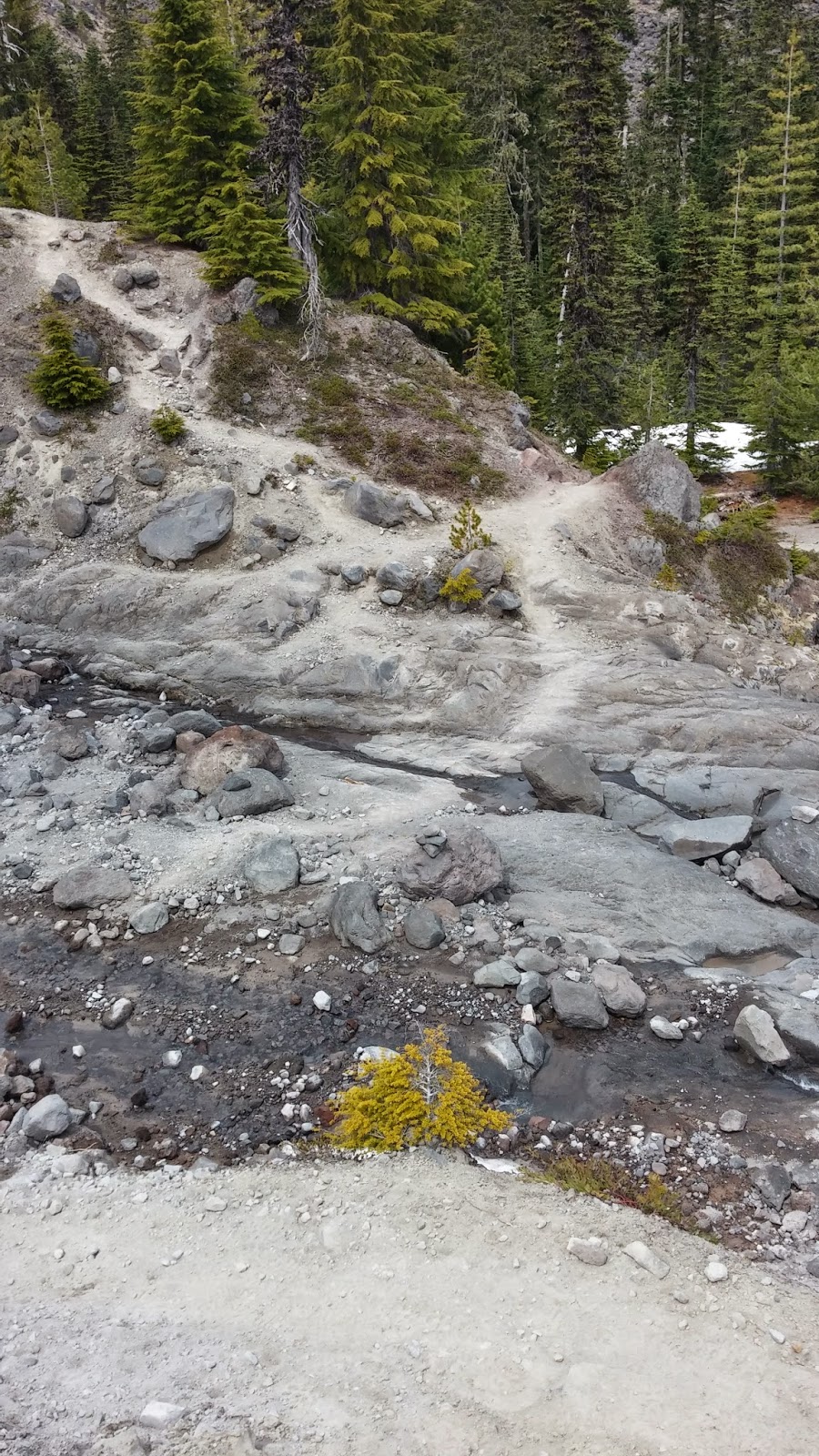
            The path was well-beaten, or so we thought, and even though the large blue diamond markers had disappeared with the trees, we could still follow the footprints of those who had ascended earlier this morning. And so up we went, over boulders ranging from the size of basketballs to the size of Buicks, through mud in which we’d sink to our ankles, over weak bridges of snow in which we’d break through up to our thighs—the sharp, jagged ice crystals cutting our bare skin, leaving thin scratches like those from the claws of a housecat.  
            Mount St. Helens is amazingly large. I’ve seen it a thousand times before, but almost always from a distance, from the city, where it looks like a white hill with its top cut off—a plateau, not a mountain. But seeing it for the first time up close, there is no argument, no other way to describe it, even if it doesn’t have a peak—it is most definitely a mountain, and absolutely awe-inspiring. I’ve actually climbed it once before, but on a different route—the easier “summer” route—but on that particular day, you couldn’t see a damn thing. It was thick with fog, the visibility, twenty, maybe thirty feet. But during peak season, the National Park Service only allows 100 climbers per day, and if you intend to climb on the weekend, you’d better reserve your permit months in advance. And if the weather doesn’t cooperate—let’s say the mountain is fogged in—too bad! No refund! Just another major flaw in the system if you ask me, one that will certainly take a catastrophe to change.
            But today is a Thursday, and we were able to purchase our permits late last night, last minute, with another 65 still available. And on the way up it was so clear—a “bluebird day,” some might say—that we could distinctively make out the other mountaineers, like ants marching in the distance. They ranged from large groups slowly clambering up, to a pair of black specs careening down in such a blur of speed that you couldn’t tell if they were on skis or tumbling franticly end over end. Though the majority of St. Helens is covered in a blinding white blanket, a handful of strips—consisting primarily of dirt, rock, and ash—run up the mountain like the legs of a tarantula. It was one of those legs that we were scrambling up when we realized that we had somehow gone off course. I could see the wooden posts two legs to the west—the wooden posts that I knew marked the route in which we were supposed to be following. It’s not that we weren’t on a route—on an exposed mountain with no trees, just about every which way is a route. We just weren’t on the easiest, most traveled one. In fact, we happened to be on the steepest, most difficult path on this side of the mountain.
           
Fortunately, we weren’t the only ones to have gone the wrong way today. The footprints we had been following must have made the same mistake as us, so naturally, we continued to follow them. Instead of continuing up a long treacherous path, the footprints darted west, and so did we. The first snowfield was no big deal—a quick dip downward, a few dozen yards at a reasonable grade, and then an easy incline up a rocky leg. It was the next crossing that got my heart pounding. It was the next crossing that brought on The Fear.
            As we stopped for a breather, I studied the steep embankment in which I knew we somehow needed to scramble down. It was nothing but loose soil and rock, with no clear path—at least nothing that I would describe as “safe.” I watched as two skiers sped by in the gully below—the gully that we needed to traverse to get back on the beaten path. Oh good, I thought. They were on skis. The other side of the ravine was even steeper, though covered in snow—a slope I knew would feel more comfortable going up than going down. But before we could go up, we had to go down.
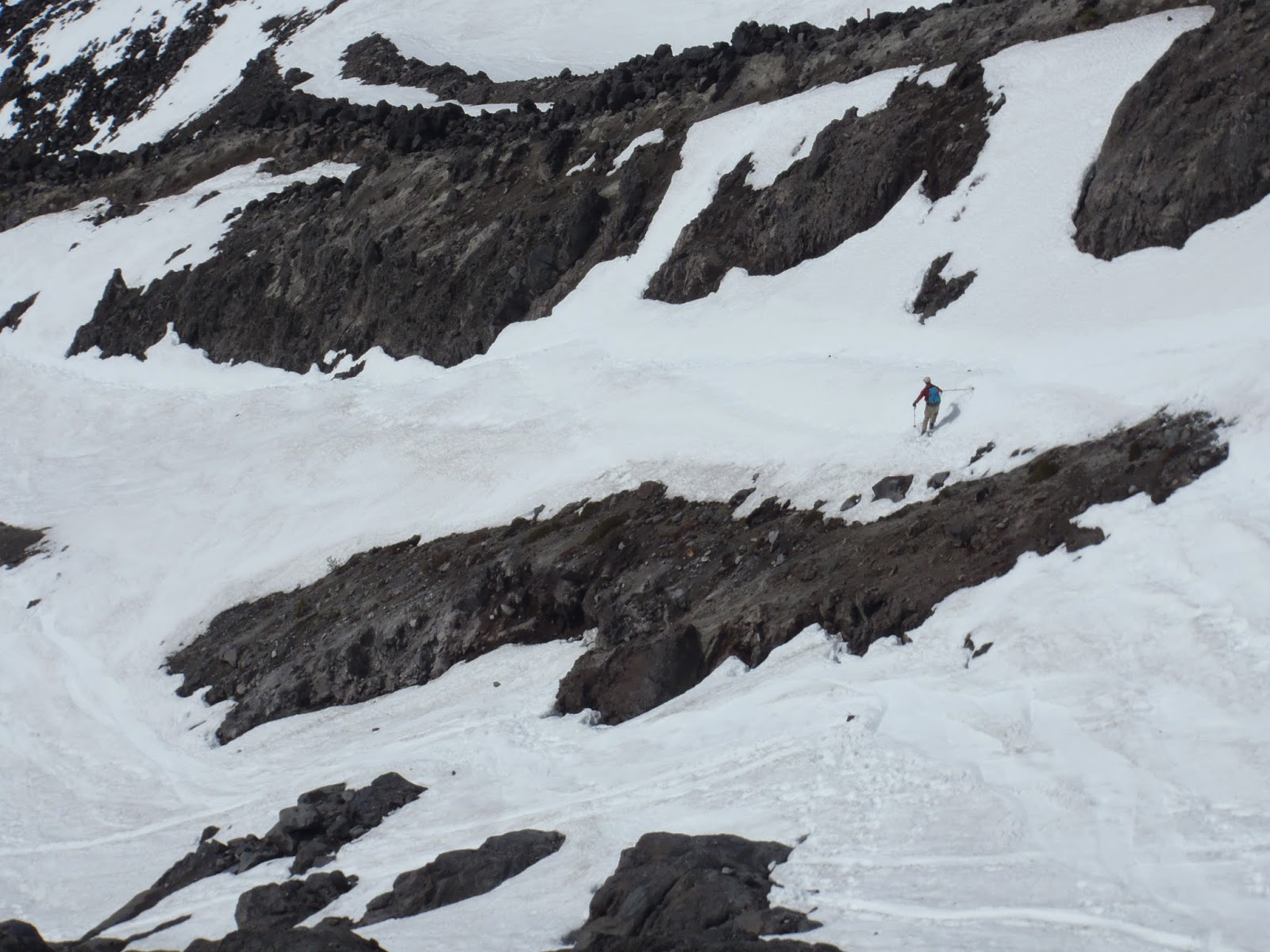
            I strapped on my helmet and started down. For some reason I crossed my feet in an attempt to find solid footing, when the ground suddenly started to slide. I quickly turned—the weight of my pack shifting my body, throwing me slightly off balance—and grabbed for whatever solid rocks I could find in front of me. But the rocks at my hands weren’t holding firm either. They felt loose, as if they’d pull right out of the ground with little effort at all. In an act of desperation, I dug all four of my extremities into the loose soil and scurried back up to the top of the ridge as fast as I could, sending basketball-sized boulders dribbling down the slope beneath me. Suddenly the mountain seemed EXTRA LARGE!
            The Fear almost always strikes suddenly. Anybody who’s ever experienced it knows exactly what I’m talking about. One minute you’re fine. The next minute you’re questioning every life decision that helped guide you to that exact moment: What if you had done this differently? Or that differently? What if you had simply stayed home this morning? What if? What if? What if? The answer is always the same. If you would have done it differently, then…well…then you wouldn’t be in this situation right now. But it’s too late, you are in this situation, and now you have to deal with it. You have to deal with that horrible sensation that’s currently rushing through your soul. You have to deal with The Fear.
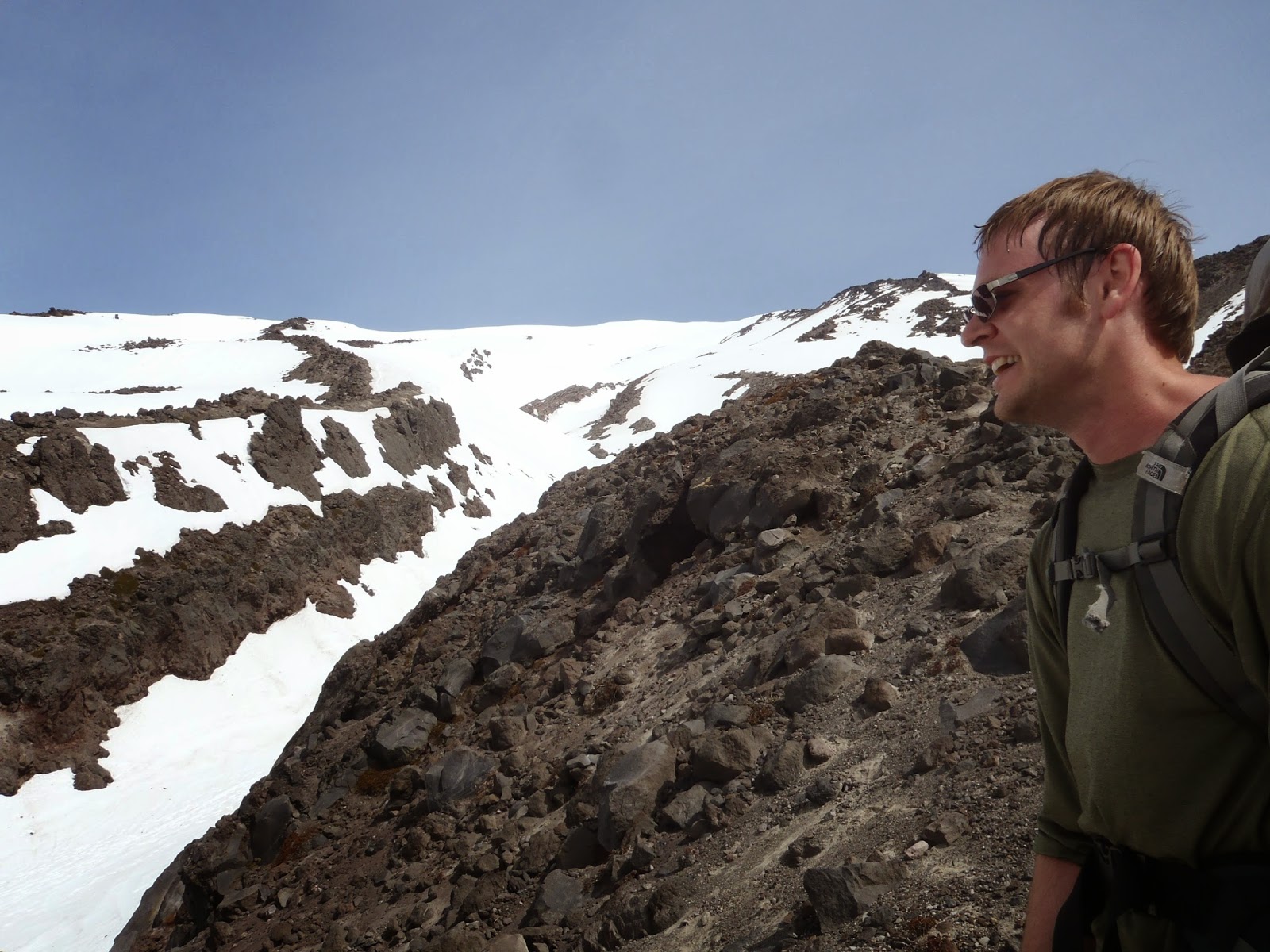
           
I’ve only experienced The Fear a handful of times in my life, and in my opinion, it never gets any easier. A few summers ago The Fear infected me three times in the span of a month—in the form of whitewater, a tornado, and a forest fire—causing me to seriously question my adventurous spirit. Though that spirit did briefly go into remission, I never entirely lost it. Perhaps it’s because the memory of The Fear faded with time, or because, for some of us, adventure is simply a way of life. Whatever the reason, it didn’t much matter as I looked down into the ravine, and then back up, at what earlier appeared to be a mountain, but now only reminded me of death.
            It’s very easy for this particular mountain to invoke the notion of death. This week happens to be the 34th anniversary of when Mother Nature decided St. Helens was just a bit too tall, bringing her down a few notches, and taking 57 poor souls in the process (I could go on and on about the 1980 eruption—the most deadly in U.S. history thus far—but this story is already growing longer than I had anticipated, so we’ll have to save the destruction for another time). Have you ever been inside an old building that felt eerily creepy and were not the slightest bit surprised to find out that someone had died there before? Well, that’s how standing on St. Helens can feel.
But it wasn’t merely the eruption that was running through my mind. Yesterday a priest from New Jersey fell off the high side of Mount Hood—a 1,000 foot vertical fall. The reporter on the local news refused to use the word “die,” or any variation of it. He just kept saying, “He fell.” He fell? One thousand feet—give me a break. Did an angel catch him? And then there’s that entire town in Northern Washington that got buried by a mudslide earlier this spring. They didn’t even know what hit them. I know…I know…these aren’t the kinds of things that you want to be thinking about when you’re in a squirrely situation, but when your mind becomes infected with The Fear, the choice really isn’t yours anymore.
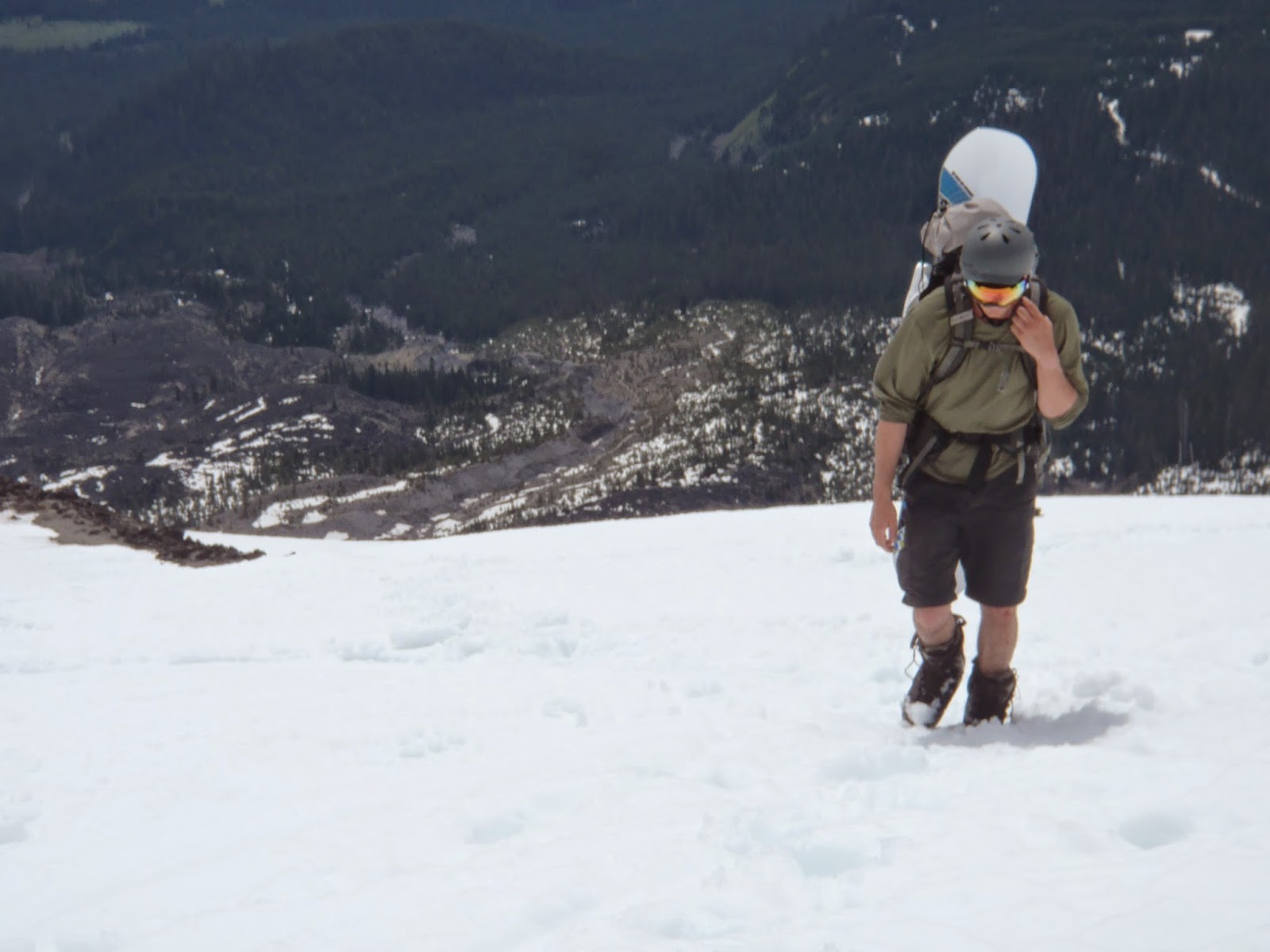
Careful not to kick any rocks down on him, I waited for Walt to make it to the bottom before I attempted my decent. To be perfectly honest, I’m probably making this seem a hell of a lot more dangerous than it actually was, but to be clear, one wrong move could have certainly resulted in death. Would it have? It’s hard to say. There most definitely would have been some severe broken bones, several contusions, even more lacerations, a helicopter ride to the hospital, absolutely no recollection of what had happened, and a possible life-sentence to the confines of a wheelchair. But would it result in death? Probably not. Could it? Yes—without a doubt.
Normally it wouldn’t even have been than big of a deal. As a child I would have jumped down the bastard, rode a landslide full of dirt like a wave, and slid across the snow at the bottom with my arms flailing in a display of triumph. The real problem was all the junk hanging from my back. I normally travel light, taking great pride in my minimalist attitude towards life. But when you’re backcountry snowboarding, there’s just no way to do it. You need your snowboard and you need your boots, and those items alone weigh more than any loaded pack I ever remember carrying. And then you have to add the water and food and extra clothing. And it’s not only the weight, but the awkwardness of the entire package—there really is no proper way to carry a snowboard up a mountain. I had mine strapped on perpendicular to my body, like a set of wings extending outward between my shoulder blades and my hips. I figured if I fell, I needed to fall backwards, hoping that the board might catch on a couple of rocks, slowing me down enough to regain my composure.
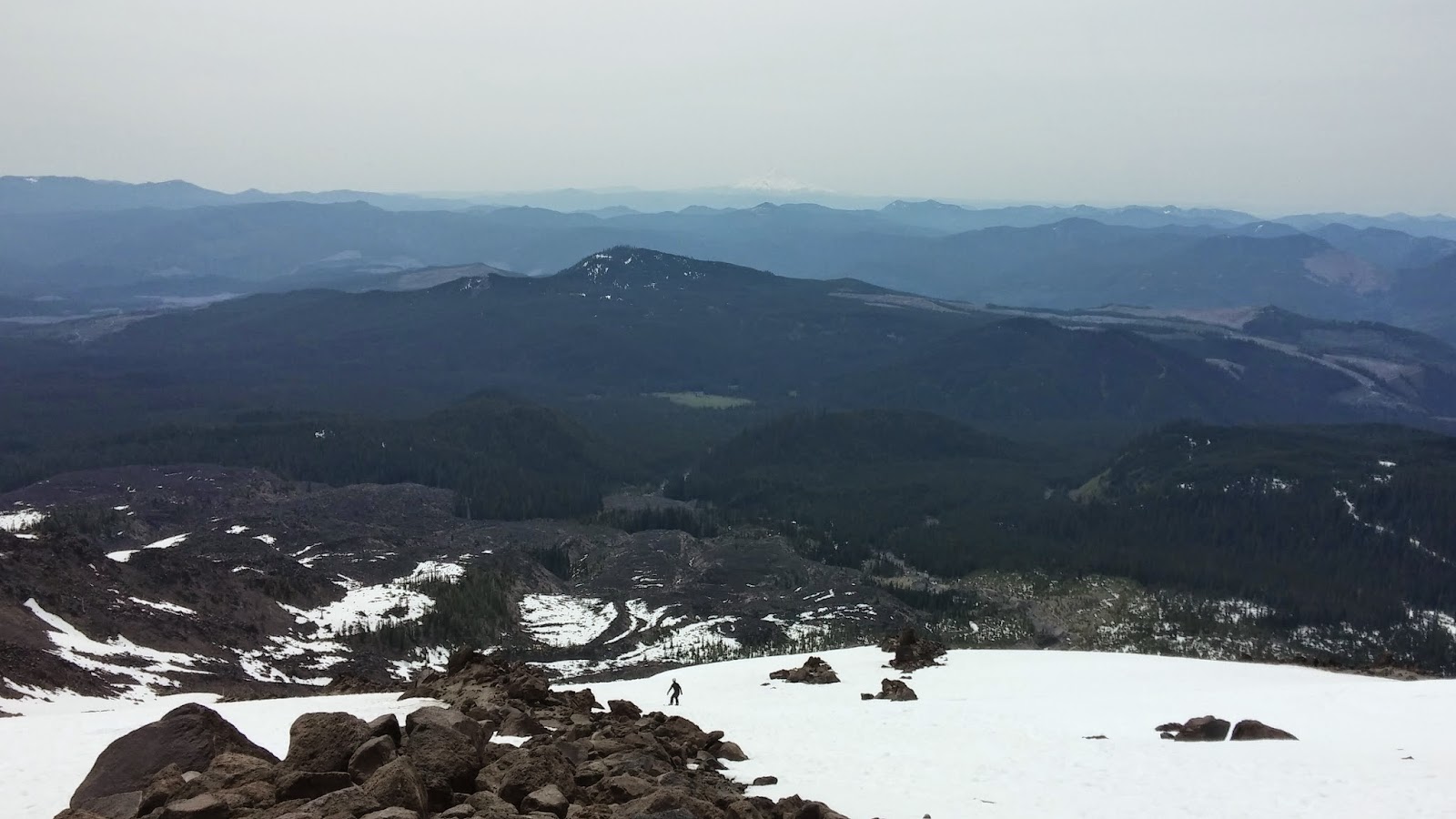
           
People react to The Fear in a variety of ways. Some panic, some cry, some curl up in a ball and refuse to move. Myself, I’ve always conquered The Fear with movement--with speed. So I scrambled down the hill without even blinking an eye, a cascade of dirt and rock flowing at my feet. I rushed past Walt at the bottom and attacked the snow covered incline like it was a competition. Crampons would have been nice, an ice axe, ideal, but I had neither. So I simply kicked my boots into the wall of hard-packed snow, stabbed through the ice with my bare hands, and climbed it like a frozen ladder. If looking down brought with it visions of death, then heading up induced revelations of life. Sure, experiencing The Fear can be a dreadful event, but one positive side-effect is that it reminds you of what is really important in life—a wakeup call, you might say. And so, as I climbed, I thought about what’s really important in my life—my writing, my friends, my family, and that beautiful woman who’s expecting to me make it home in one piece so I can take her out on a date tonight. Desiring a life of adventure is one thing, but if you don’t make it home safely, then it’s all for nothing.
            “You guys are crazy!”
            When I finally made it over the edge, my feet firmly on solid ground, I noticed a man sitting on a rock, chewing on some jerky.
            “Yeah, that was a little sketchy,” I reply.
            “I can’t believe you went down that.”
            I waited patiently for Walt to appear from the abyss, wondering what I could possibly tell his family if something was to happen. When he told his parents of our plan, his mother replied with, “You’re really still friends with that guy?” As if we were children, and I was the kid who encouraged the others to jump off the highest point on the playground. I let out a sigh of relief when I see his blond hair poke over the snowy edge.

            Unless he was faking it, he wasn’t nearly as rattled as I was. But then again, he’s definitely more of a mountain man than I’ll probably ever be. As much as I’d love to someday write in my autobiography of my “mountain man” years, it’s probably not it the cards. I grew up in the flat lands. Walt actually grew up in the mountains and buys a lift ticket every year. It’s funny, because in the past, if something happened to go wrong—like, let’s say a forest fire—I was the one who always kept my composure. This time it was Walt. This time we were in his element.
            As we continued up the mountain—again on the beaten path—I would look over at the sea of snow and think to myself: There’s no way I can snowboard down that. Not after The Fear traveled through my soul. But Walt kept reassuring me that it would be fine; that it wasn’t nearly as steep as it looked.
            And so, here I am—5,200 feet above sea level, a snowboard strapped to my feet, staring down a snow-covered mountain that’s already broken my confidence once today. And now I’m supposed turn my board, and slide down the bitch. Oh boy! Did I mention that this is only my third time ever snowboarding, and that the first two times were on Mount Hood, at an actual resort, with lifts, and runs, and emergency personnel? Maybe I’m not quite ready for backcountry snowboarding. Maybe I should have thought this through before coming up with the idea just last week and then convincing Walt to tag along. Why did I think I could go from Hood to St. Helens without any proper backcountry experience?
            “How do I do this again?”
            “Oh, just do it already!”
           
Walt’s right. Screw it! I turn the board and start down the mountain and immediately remember that this is supposed to be fun. And it is. And it’s easier than I recall it being the last two times. I head to the right, slow down, head to the left, and then repeat. After a hundred or so yards, I stop, unstrap the board and hike back up to Walt. “Let’s go higher,” I say. The Fear is gone.
            We hike up another thousand feet, decide that we’ve climbed high enough for the day, strap on our boards, and careen down the mountain, across fields of snow, through narrow gullies filled with obstacles, until we run out of the white stuff. And then we clip out of our bindings and huff it back to the parking lot, compiling our stories along the way.
            “I don’t know if I should tell my wife about the ravine,” Walt says.
            “You might as well, because I’m definitely going to write about it. That was rad!”
            “I think it was more epic,” Walt says, continuing an inside joke about the way snowboarders are perceived to talk.
             “I'm not quite sure if it was rad or epic,” I say. “Today I’m going with wild.”

*Some photos courtesy of Walt.