Wednesday, July 15, 2015

One Week in July in America, 2015


             Last year, around this time, I wrote a blog entitled: “One Week in July in America, 2014.” I thought it might be an interesting social document, to help future generations better understand what a typical week was like in America in 2014. My hope was that a hundred years from then, some future American might grow tired of their virtual reality sex chamber and decide to do some historical research. Perhaps they would pour themselves a large mug of Mountain Dew Crystal Meth Suicide Blast™ soda pop, strap on their Weblet 2®,  and surf Twitoogle Book© for: “What were Americans up to a century ago?” Then maybe, just maybe, they would stumble upon that blog post. Well, a lot has changed since last year. Among other things, weed is now legal, gay marriages are now legal, and Tom Brady is now a proven cheater/liar/horrible human being! With so many changes, I thought it might be fun to do another installment. So, here goes: ONE WEEK IN JULY IN AMERICA, 2014  2015.
            Airplanes. It’s been almost two years since I started dating my girlfriend, Katelin, so I thought it might be time to introduce her to my family and friends from back home. The only problem being: “back home” is over 3,000 miles away. Now, I know that in the future this might not seem like a problem. You simply hop in your Toyota Transpod®, press a button, and poof! you arrive at your destination in less than a millisecond. Well, here in 2015, long distance travel isn’t nearly that efficient. Like livestock, we are packed into giant metal cylinders that are propelled thousands of feet into the air until they reach their destination. Except, you aren’t allowed to reach your destination until you stop at another destination first, where you are forced to wait on the most uncomfortable seats in the world and purchase food that is astronomically priced. They call this a layover, and unfortunately for us, we were laid-over in a city that still thinks that Tom Brady is NOT a cheater/liar/horrible human being! That city is called Boston, and I pray, for the sake of humanity, that in your future, it has been destroyed and replaced with a better city, which calls itself New New York.
            Waterfalls. In the mid-1990’s, an all girl group who called themselves “TLC” recorded a hit song with a popular refrain that said: “Don’t go chasing waterfalls, stick to the rivers and the lakes that you’re used to.” Anybody who’s ever seen a magnificent waterfall knows that TLC was full of shit. Of all the forms H20 can take, waterfalls just might be the best. In Letchworth, and Niagara Falls—less than 100 miles apart from each other—we visited some of the most beautiful waterfalls in the United States. At Niagara Falls, we took a ride on the Maid of the Mist, which brought us so close to the base of the world’s largest falls that we were literally blinded by its spray. It was one of the great moments of my life, one I’m sure the fine women of TLC must have never experienced.
            Games. It can be an exhilarating experience when you first walk into a casino, with all the fountains and bells and lights and fun noises. The one we visited in Niagara Falls even had a live rock n roll band playing on an elevated stage above the gaming floor. But when you take away all those bells and lights and fun noises, all you really have is people feeding money into machines like a reverse ATM. Think about it the next time you go to a casino—it’s probably the most insane thing you will ever lay your eyes on.
            Games. I’m pretty certain in the future men will playing football on horseback with bows and arrows, but here in 2015, the most popular game of summer is baseball. Sure, people might believe the sport is boring, about as exciting as watching paint dry (which itself is a thousand times more exciting than watching soccer), but it is our nation’s pastime, and holds a rich sense of history and tradition unlike any other sport we have. Much of this history and tradition is housed at the Baseball Hall of Fame and Museum in the small town of Cooperstown, NY, which, with a short visit, I was finally able to cross off my bucket list. Induction into the Baseball Hall of Fame, is based upon a player’s record, ability, integrity, sportsmanship, character, and contribution. And, that player must have played at least ten years in the majors. Or, any bum off the street can pay $80 for an annual membership. Which I gladly did. Yes, that’s correct, 2015 is the year I, Jon Penfold, became a member of the Baseball Hall of Fame. Suck it Pete Rose!
            More games. We played games—lots of games. In Upstate New York, there’s not much to do, so people drink, and when people in Upstate New York drink, they like to play games (I think it makes them feel less like alcoholics). While in New York, Katelin and I played games, lots of games. We played slots, blackjack, spinning wheel, corn-hole, billiards, Kan Jam, ring toss, yard beer-pong, trivia, shuffle board, darts, and whiffle ball. And during each of these games, we drank. And the end result of each of these games was me losing. No joke—I lost at every single game I played all week.
            Winning. I hate losing. I hate it more than most things in life. But a funny thing happened when I was visiting New York—I didn’t care if I lost. Not the slightest. Because even though I was losing, it was the people I was losing to, and with, that made the experience more than worthwhile. Sure, I may have lost at the casino, but spending time with my parents was worth every penny. And I may have lost at whiffle ball to a bunch of drunk kids, but it was still wonderful to see my family. And though Katelin and I may have lost to my sister and my friend Josh at shuffle board, and billiards, and darts, seeing the smiles on everyone's faces was a much better victory in itself.
            You see, win or lose, it’s not the destination that makes the trip, it’s the people you get to experience it with. It’s your friends. It's your family. That’s what’s most important. Even in the future, even a hundred years from now, you will still understand this, because without friends, without family, are we even really human?
            Wait, what’s that? In the future, you aren’t human…in the future you are machines. Damn, I knew I should have gone to see Terminator Genisys last week instead of playing so many damn games.


Thursday, July 9, 2015

Hotdogs in Heat (An excerpt from "The Road and the River: An American Adventure")


Watching the news over breakfast, on a giant flat screen TV in the hotel’s dining room, the weatherman tells us that it could easily reach 100 degrees today, with the humidity making it feel like 120, the Amazon being the only place in the world with a dew point as high. Jack and I walk out of the hotel and the heat hits with such a force that it feels like we’re entering another world altogether. The air is so thick and so sticky that you’d think maybe—if you could wave your arms and legs fast enough—you might just be able to get off the ground and swim from place to place.
We cut through the Guthrie Theater, mostly to enjoy its air-conditioning, and then head into the heart of downtown. There is a tennis match going on in a city square and we sit for awhile taking in the grunts and groans of two sweaty women battling it out in the grueling heat. We make it through a set before we both admit that we have no interest in tennis.
It’s only mid-afternoon and we start drinking, because after all, we are river men, and when river men are not on the river, that’s what we do; we drink. We hit up a bar where the entire staff is decked out in Minnesota Twins gear. They wear their caps and jerseys with numbers and letters embroidered on the back, spelling out names like Morneau and Mauer, Thome and Nathan. The first game of a doubleheader just finished up and fans begin to trickle into the bar to order postgame celebratory beers.
We hit up a couple more bars, drink a few more drinks, and then buy a pair of tickets from a scalper for the second game of the doubleheader. As soon as we make our way through the gates it becomes apparent just how the people of Minneapolis feel about their sports teams, for even in this record heat, on a Monday night, the stadium is filled to capacity.
We score free baseball caps by filling out fake info on credit card applications, because after all, we are river men and when river men are not on the river, that’s what we do; we con the town’s people. With new tightly-fitted caps, we take our seats along the third base line, high on the upper deck, above the action with a clear view of play, but at such a distance from the game that there’s little chance of a foul ball finding its way this far from a player’s bat.
The sun has begun to set but the heat seems to be sticking around. Earlier, during today’s first game, half a dozen fans were taken to area hospitals for heat-related illnesses. Many players on both teams were given IVs between games to replenish lost fluids. And even though there are water stations situated throughout the stadium, and I’ve drunk my fair share, I still feel as if I’m melting into my seat, becoming one with the folding plastic chair.
The Twins take an early 1-0 lead in the 3rd from an RBI single off the bat of All-Star catcher Joe Mauer, and it’s around this time that I see an advertisement on the jumbotron that says every Monday is $1 hot dog day. I immediately find the nearest concession stand and slap a five-dollar bill down on the counter. “Five hot dogs,” I say. Now, I know that a dollar for a hot dog may not seem like that great of a deal, but for those of you who do not attend many games, you must understand that it’s probably the greatest deal in the entire world of professional sports. Today’s stadiums have a tendency to inflate their prices at astronomical rates. A single beer is usually more expensive than an entire six-pack at a convenience store, and the price they charge for a small bag of peanuts could get you enough in the bulk section of any grocery to feed an elephant. You’d think that their soda prices would calculate into being the most expensive way anybody could possibly purchase sugar; that is until you see their cost for cotton candy. And as for the hot dogs, on any other day of the week, they would cost $6 apiece, so tonight I’m getting them at an 83% discount!
The Indians take a 2-1 lead in the 5th and Minnesota quickly answers back in the 6th, tying it up with a 381 foot home run from Valencia, his 11th of the season. I return to the concession stand and buy five more hot dogs and a single beer that is more expensive than all the food combined. I try giving some of the dogs away to the fans in the neighboring seats but nobody seems as excited about the all-beef franks as I do. Jack eats one and I consume the other four.
Cleveland scores two more in the seventh and another two in the ninth. Before the game ends, I hurry back inside to get five more hot dogs. “Why’d you get more hot dogs?” Jack asks. “There’s no way that you could still be hungry.”
            “At this point,” I say, “it’s not about hunger; it’s about taking advantage of a great deal. You’re a math teacher, you should understand. Fifteen hot dogs, at six dollars a pop, what’s that add up to?”
            “Ninety dollars,” he says without hesitation.
            “And I only paid fifteen. It’s like I just made seventy-five bucks.”
            “No,” Jack says. “It’s like you just ate fifteen hot dogs.”
            “Fourteen,” I say. “You had one.”
            “That’s still disgusting.”
The game ends, and there is little joy in Minnesota, for the mighty Twins have lost. We hit up a couple more bars and drink a couple more beers between the stadium and our stop. The sun has disappeared for the day and the temperature has dropped by ten degrees but it’s still in the 90’s and the heat finally seems to be getting to me.
We get on a bus and ride it for half an hour before realizing that we got on the wrong one and are traveling in the wrong direction. We get off at a gas station and call a taxicab. I drink a couple of Gatorades while we wait, but it does little to help. I begin to feel sick.
The hotel’s air-conditioning is a welcoming relief and within five minutes Jack is in his bed snoring. But I can’t sleep. My head hurts. My stomach is churning. I have heat exhaustion; there’s no doubt about it. I stumble into the bathroom and hug the toilet bowl like it’s a long lost friend, its surface, cool and refreshing to the touch. An entire day’s worth of fare is released, exiting through the same place it entered—beer and hot dogs and Gatorade and more beer and more hot dogs. I make noises like a dinosaur in heat and am surprised that Jack doesn’t wake. When I think it’s over I stumble back to my bed and try to lie down but within a minute I’m back in the bathroom, losing more hot dogs. What was I thinking? What kind of idiot eats so many Goddamn hot dogs? I won’t go into details, but a dozen or so half-digested hot dogs floating in a pool of water is not the prettiest sight in the world, and now the image is burned into my mind like bad 1960’s pop-art, and it makes me wonder if I’ll ever again be able to eat another hot dog, which makes me sad, because I really like hot dogs.


Tuesday, June 30, 2015

The Moral of the Story


One of the things that sets country music apart from other genres is that many songs contain a moral. By the end of the song—hidden somewhere between the fiddle and the steel guitar—the listener either learns a new lesson, or more likely, is reminded of an old one that had been forgotten somewhere along the way. This is not a country song, but it is a story about a country song, and I have a good feeling that by story’s end, we might find ourselves a moral of our own.

            My best friend Tex and I were at that age where we were old enough to go to war but not old enough to drink, which only encouraged us to drink that much more and that much harder. Though we were year-round drinkers, it was always Independence Day weekend that we really seemed to hit our drinking apex. We would start early in the day, at my uncle’s annual Fourth of July party, before heading down the road, where we continue drinking all night at a rough and rowdy country music festival.
            That year the headlining act was Neil McCoy, the most famous Native American country singer of the 1990’s. But by this time, he hadn’t had a hit in years and Tex had never even heard of him. “Does he have any good songs?” he asked me.
            “Not really,” I answered. “There’s one song of his I like. It’s called ‘I Was’.”
            The concert started and Neil McCoy sounded just downright awful, like he was forced to play the show against his will. We tried to enjoy ourselves but it was impossible—the music sounded too horrendous. So, we drank, hoping the alcohol would turn a bad thing good, as it occasionally does. No use. So, then we drank some more. And then some more. I was merely getting wasted, but Tex was getting angry. “This guy is just plain awful!” he complained. “When is he going to play that song you like?”
            “I’m sure it’ll be next,” I assured my inebriated buddy. But it wasn’t next. And it wasn’t the song after that.
 Every time a new song started, Tex would ask, “Is this the song?”
And every time I would answer, “Nope, not this one.”
By the time the show started winding down, Tex was furious. “Why doesn’t he just play the goddamn song?” he demanded to know.
Finally, the show ended. There was no encore. The fireworks started and Tex was hot. “That bastard didn’t play your song!” he yelled as he walked towards the stage. “Follow me.”
“Where are we going?”
“To find Neil McCoy!”
We ducked under the stage and made our way behind it, to where the country singer’s tour bus was parked. Tex banged on the door. A short fat man answered. “What the hell do you want?” he asked.
“I want that son of a bitch Neal McCoy to grab his guitar, get his ass out here, and play ‘I Was’.” Tex said confidently.
The man in the doorway looked around. “How the hell did you guys get back here anyway?” he asked.
“That doesn’t matter,” Tex replied. “The only thing that matters is that Neil McCoy gets his ass out here and plays ‘I Was’.”
Without saying another word, the man slammed the door in our face. Tex immediately started knocking on the door again, but stopped when a group of police officers began walking our way.
“What are you guys doing back here?” one of them asked.
“We’re here to see that two-bit performer Neil McCoy,” Tex said.
“If you guys don’t leave right now, we’ll arrest you for trespassing.”
“Arrest me?” Tex yelled. “I dare you to arrest me.”
The cop took the dare. He slapped Tex in cuffs and led him away. “Do you want to get arrested too?” Another cop asked me.
“No sir,” I replied before running away.
I made the long walk back to my Uncle’s house, where a few drunk men stood around a fire. “Where’s Tex?” one of them asked.
“In jail,” I answered.
“Jail! What the hell happened?”
I told them the whole story, everything from Neil McCoy’s horrible performance to the song that he never played.
“What’s the name of the song?” One of them asked.
“ ‘I was’.”
“Are you sure that wasn’t an Aarron Tippen song?” Somebody asked.
“I think it was Joe Diffie,” said another. “Sounds like Tex went to jail over some bad information.”

So, the moral of the story? You might think that it’s not to heckle washed-up country singers, but it’s not, because this is America, and at some point in everybody’s life, they will find themselves heckling a washed-up country music singer. Maybe you think the moral is to know which washed-up country singer sings which song before demanding that they perform it for you, but it’s not, because it turns out that I was right—Neil McCoy did sing ‘I Was.’ (It reached #37 on the Billboard country music charts in the spring of 1999.) I was just the only person on Earth to remember such on obscure song. No, the moral of the story is simple: Don’t ever dare a police officer to arrest you. Because they will.


Wednesday, June 24, 2015

My Goonies Adventure (Part 4 of 4)


Note: In celebration of the 30th anniversary of the theatrical release of The Goonies, I will be sharing my own true "Goonies" story throughout the month of June. Thanks for reading, and remember: "Goonies never say die!"

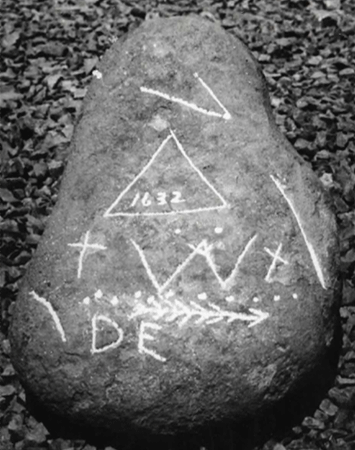
            Over lunch I finished reading Tales of the Neahkahnie Treasure and came to my own conclusion concerning the riches: they didn’t exist, and probably never did. Researchers Don Viles and Wayne Jensen both proposed similar theories concerning the mystery. According to the men’s separate studies, the engraved rocks found scattered across Neahkahnie Mountain have nothing to do with pirates after all. The “1632” on the rock in the Tillamook Museum represents 1632 yards (apparently I wasn’t the first to believe the number was a measurement). And when that exact distance was measured north from where the rock was originally found, another mound of stones rose from the ground. They were survey markers, presumably made by the English explorer Francis Drake and his crew of the “Golden Hind,” in 1579. They were merely staking out the land, claiming it for their mother country.
            So if a four century old explorer can explain the rock engravings, then what about the story that has been passed down for generations? Well, the Coastal Native Americans have long been known for their elaborate story telling. Perhaps they saw Francis Drake and his men doing their survey and presumably had little idea of what they were actually doing. Or maybe the story is just that, a story, passed down throughout the years to trick the white men into a wild goose chase. Or maybe there were pirates, and there is a treasure hidden somewhere beneath the earth of Neahkahnie Mountain. But after all, translated in the Tillamook language, Neahkahnie means “the place of the supreme deity.” So it seems unlikely that the Native Americans would want anybody honeycombing over their sacred grounds. The debate can go on forever, for only the treasure’s discovery will ever truly prove its existence.
            The following morning, heading north out of Nehalem Bay, I stopped one more time at Smuggler’s Cove, not to look for riches, but to soak in the real treasure. As I was leaving, hiking up out of the woods and across a clearing full of waist-high brush, I spotted two men well off trail. They were bushwhacking through the weeds and high grass, heading towards the cliffs that climbed over the water’s edge. I stopped and watched, curious of what they were up to. When they reached the lip of the drop-off, they stood there pointing at a precise spot, presumably discussing what to do next. There was little doubt of what these guys were doing, and who they were: treasure hunters. Were they wasting their time? Only as much as I was, or anybody else for that matter. If somebody’s going to have a hobby, treasure hunting seems to be as good as any. At least they’re outside, in the sun, not sitting around watching television or playing video games.
            I rode north to Astoria. There was one last thing I needed to do before traveling home. From route 101, I took a right onto Leif Ericson Drive, another right up the 37th Street hill followed by a left at the stop sign on Duane Street and another left on 38th. The road is unpaved, gravel and stone. A small sign sticks out of the ground that reads: “Private Drive, Goonies Welcome on Foot, No Cars, Thank You!”
            I walked up the drive, the sound of seals carrying out of the Columbia River. The ground flattens out and sitting off to the right, there it is: the “Goonies” house. It looks almost exactly like it did in the movie, 25 years ago. It’s still white with black trim but doesn’t have the elaborate mechanism to open the front gate. There are newly added skylights and grey concrete blocks with blue flowers in the front. American and Israeli flags hang from the front porch. There is no number, but it must be somewhere between 344 and 384, the addresses on either side. Two houses over, the home is for sale by the owner. Looking out over the entire village of Astoria, it would be an ideal place to live. I call the number on the sign and find out they are asking $280,000 (way out of my price range). Before leaving I lift up my shirt and do a quick truffle-shuffle, reliving an important part of my childhood, if only for a moment.
           On my way back to Portland I think about treasure, and more importantly, the hunt. When the “Goonies” discovered One Eyed Willies’ pirate ship and the treasure inside, that was it, the hunt was over, and so was the film. We never heard from the “Goonies” again. So it makes me think about what is more important in the grand scheme of things: the treasure or the hunt? During the search there is that anticipation, the lure of adventure, the unknown always lurking ahead. And if you’re lucky, and there is a discovery, then what? It’s over. Maybe you’re wealthy, maybe you’re not, but you’ve definitely lost something, a piece of your imagination, a part of your mindset that can only be harnessed in pursuit. So I head back to Portland, back to my cheap apartment and a less enthusiastic kind of hunt: for a job. Am I wealthier? No, not in the slightest. But richer? In terms of life experiences, I’d like to think so. Everyone should go on a treasure hunt once in their life.


Wednesday, June 17, 2015

My Goonies Adventure (Part 3 of 4)


Note: In celebration of the 30th anniversary of the theatrical release of The Goonies, I will be sharing my own true "Goonies" story throughout the month of June. Thanks for reading, and remember: "Goonies never say die!"

             
             I got an early start, riding north on Highway 101, its winding blacktop carved into the side of Neahkahnie Mountain. After turning off into Oswald West State Park, I descended down to the beach at Smuggler’s Cove where about two dozen surfers were riding waves that climbed no higher than three feet. I walked around the rocky shore searching the ground for chunks of beeswax, but found nothing. As I sat on the trunk of a fallen tree and watched as the waves crashed in, a beautiful woman walked by with a baseball-sized rock in her hand. “Did you find a good one?” I asked.
            “I like it,” she said as she held it out for me to see. “It’s got all these speckles of blue in it.”
            “Neat,” I replied. “Do you come down here often?”
            “As much as I can.”
            “Do you ever find any chunks of beeswax?”
            “No,” she giggled with a puzzled expression on her face.
            “A few hundred years ago a ship crashed around here, spilling a load of beeswax,” I explained.
            “Well, I’ve never seen any.”
            “There’s supposed to be a treasure buried around here too,” I added.
            She smiled as she started to walk away, “Look around,” she said, “this is the treasure.”
            And maybe she was right. Maybe the beauty wrapped in the waves that crashed against the beach of that secluded cove was richer than any chest full of gold. But then again, that doesn’t mean a man can’t dream. Staring back up at the mountain I thought about the clue, “Travel one mile east of the beach at Neahkahnie to an enormous fir tree…” All I could see were enormous fir trees. They were everywhere, their trunks climbing high into the air, their branches stretching in all directions, darkening the forest below. And then I thought back to a picture that was on display at the Tillamook History Museum. It was black and white, and featured the whole mountain, but there were no trees; the ground was almost entirely clear cut. In the long scheme of things the photograph is a rather modern invention and so if the treasure was buried over 300 years ago, then that means none of the trees were even here at the time. So not only is the “enormous fir tree” from the clue most definitely history, but there’s a good chance that the treasure is now buried under a few thousand pounds of still growing hardwood.  
            Leaving the cove, I spotted a rock lying in the middle of the trail. It was size of a baseball, and had speckles of blue littered throughout. The woman had left it behind, perhaps for me to notice, telling me to let it be, that the treasure is better left unfound. I decided to hike to the top of the mountain, to get a better perspective on things. The higher I climbed, the more I realized how absurd it was to ever believe that a pirate’s treasure could possibly be discovered buried in this land. Hundreds of acres of dirt and trees, houses and roads, and the riches could be anywhere. Sure, there were the clues, the stories, and the carvings in the rocks. But any of those things could be deciphered a thousand different ways. It would be like finding a needle in a haystack, but at least in that situation there is actually a needle to be found.
            By the time I reached the summit any idea of finding the Neahkahnie treasure had just about evaporated from my mind. The sure vastness of the mountain alone is enough to derail even the biggest dreamers. And then there is always the million dollar question: why would anybody bury a load of riches? Seriously, think about it. There are plenty of things to do with a treasure rather than burying it; like spending it, for instance. And let’s say that the treasure was indeed buried somewhere on Neahkahnie Mountain, who’s to say that it wasn’t already found, it’s discoverer keeping the secret to himself, as not to have to share the loot with anybody else. So as I sat in the sunshine, on a rock at the very peak of the mountain, I gave up on the Neahkahnie treasure and stared out across the Pacific Coast, watching as miles of blue water rolled into its sandy beaches.
            I traveled back down to Nehalem to have lunch, and just as I was about to enter a local tavern a voice came from behind, “Did you find the beeswax you were looking for?”
            I turned around to see the beautiful woman from the cove. “No,” I said, “but I saw that you left your rock laying in the trail.”
            “It was too pretty to take,” she said with a smile. “I decided to leave it for somebody else to find.”
            I don’t exactly know why, but for some reason, that was the answer I was looking for. In just a few words she had summed up my treasure hunting experience. “Leave it for somebody else to find.” Yes, that’s what I would do.

To be continued...


Wednesday, June 10, 2015

My Goonies Adventure (Part 2 of 4)


Note: In celebration of the 30th anniversary of the theatrical release of The Goonies, I will be sharing my own true "Goonies" story throughout the month of June. Thanks for reading, and remember: "Goonies never say die!"

The story of the Neahkahnie treasure is a simple one. Centuries ago, both the Clatsop and Tillamook Indians told white settlers the tale of a “winged canoe” that landed on the beach just south of the mountain. Somewhere in the vicinity the Indians watched from a distance as several white men dug a hole, filled it with a large chest, placed a dead body over it for protection, and then covered it with dirt. But the legend doesn’t stop there. Around the same time a ship carrying a large cargo load full of beeswax crashed in the same area, most likely the San Francisco Xavier, a Spanish galleon on its way to California. The two very similar stories have caused debate throughout the years whether or not it was the same ship that carried the beeswax and the treasure. What historians do know is that a treasure has never been publicly found, but thousands of chunks of beeswax have.
            As neat as it was to view a chunk of history with my own eyes, the beeswax was not what I was looking for. I spent another hour searching the museum with no luck, until I ventured into the basement which contained local historical artifacts that had been collected throughout the last couple centuries. In a glass case just left of the stairwell I finally found what I had come to the museum to see. The rock was somewhat larger than a basketball, presumably much heavier, and engraved with strange markings. On a notepad I sketched out a small scale replica of the drawing: a horizontal line, underneath it an almost perfect equilateral triangle with the number 1632 inside, below the triangle a large W with a cross (crucifix style) on either side, below that another horizontal line with eight slashes through it, and then finally the letters D E L at the very bottom.
            I had no idea what any of it meant, but the triangle could clearly represent a mountain. And when most people would probably assume that 1632 was a year (the exact same year written on the map in The Goonies), I immediately thought it was a measurement (hopefully a notion that was mine alone). The rest remained a mystery. What was certain was that the rock was found somewhere on Neahkahnie Mountain, along with several others with similar markings, the first discovered around 1890. Unfortunately, few living people know precisely where the rocks were found, and they were keeping that knowledge to themselves.
            As I stepped back from the case my left foot landed with a thud, the kind of sound something makes when it is hollow. I was standing on a one foot square piece of plywood, painted the exact color of the concrete. Something seemed off. “The Goonies” instantly came to mind, the scene when they’re in the basement of the restaurant and they find a hidden passageway in the floor. I quickly looked up the staircase as to make sure nobody was coming, and then bent down, digging my fingernails between the thin crack that separated the two materials. After several seconds of prying, the board came up, and underneath it—nothing! Dirt. But still, the embarrassment of being caught was well worth the risk of never knowing.
            Back upstairs I searched the library for any more valuable information on the Neahkahnie treasure. Some local collections turned up little, but just as I was about to leave, a paperback caught the corner of my eye. It was small and blue, at 25 pages, more of a pamphlet than a book. The title said it all, Tales of the Neahkahnie Treasure, prepared by the Nehalem Valley Historical Society Treasure Committee in 1991. A stroke of luck, my research had already been done for me.
            I paid four dollars for the book, left the museum and set off north for Nehalem Bay State Park. After fighting sweeping headwinds for nearly thirty miles I reached my destination, set up camp, and headed straight for the beach. In the distance the mountain didn’t look like much—more reminiscent of a hill, or a large dome, without a summit point—unlike the high peaks that traditionally come to mind when one pictures a “mountain.” If the triangle engraved on the museum rock was indeed a mountain, it’s hard to believe that this was the one. 
            That’s it. I thought. That’s the mountain, and nobody could find a treasure buried in it? Walking toward it, the closer I got, the more my view changed (literally and figuratively). The hill grew substantially with every step, growing wider at the base and climbing higher into the sky. From where I started the mountain appeared so very close, but after an hour of trudging through the sand I still hadn’t even reached its base. The cliffs that climbed up the west side, waves crashing into their rock walls, were ten times taller than originally perceived. As the sun set, causing a horizon line as red as blood, I stretched my head upwards and decided: yes indeed, no doubt about it, this is a mountain.
            By the time I made it back to camp it was dark. I hung any open food on the low branch of a tree (seriously expecting it not to be there in the morning), climbed into my sleeping bag, and began to read Tales of the Neahkahnie Treasure. There’s a quote in The Goonies that older brother Bran says about the treasure: Everybody and their grandfather went looking for that. As my fingers flipped through the pages of the book, I quickly realized that the same held true for the Neahkahnie Treasure; and as for Chester Copperpot-- the fictional treasure hunter who dedicated his life searching for the Goonies’ riches-- there were plenty of real-life characters that lived life with similar aspirations. Enthusiasts used every means possible to try and crack the mystery. They came up with complex mathematical formulas and used advanced technology such as long range metal detectors and excavating equipment. They relied on dreams and even sought advice from psychics. Some even believed that the treasure was of biblical importance, containing ancient scrolls written by Moses (Yes, the guy who parted the Red Sea). Jobs, homes, and fortunes have been sacrificed in pursuit of the dream. In 1931 two men were even killed when their tunnel collapsed in on them. The hunt has been going on for so long, and so many cavities have been dug throughout Neahkahnie Mountain that people now refer to it as the “mountain of a thousand holes.”
            I fell asleep with treasure on my mind and woke to the sound of something tearing through the saddlebags on my bike. I crawled out of my tent and was face to face with three of the fattest raccoons that the world has ever seen. For the next forty five minutes we played a game where I would throw dirt at them, they would flee, and then minutes later scurry back toward the bag. Upon realizing that they were relentless and would never give up, I eventually removed all the food from my bags and threw it a good distance from the tent. In the morning I was astonished to find that the food that hung in the tree was hanging there still. How they knew that there was factory sealed food in my bags still remains a mystery.

To be continued...


Wednesday, June 3, 2015

My Goonies Adventure (Part 1of 4)


Note: In celebration of the 30th anniversary of the theatrical release of The Goonies, I will be sharing my own true "Goonies" story throughout the month of June. Thanks for reading, and remember: "Goonies never say die!"

            
            “Chester Copperpot, he was a pro. He didn’t make it this far.”
            The phrase echoed through my head as I stood on the beach at Smuggler’s Cove and stared up at Neahkahnie Mountain. Legend says that somewhere on the hillside, buried deep beneath rock and dirt, rests a chest full of riches—a pirate’s treasure that’s been hidden for over three hundred years. Throughout the previous century thousands of people had searched the mountain with little luck, but I figured my chances were as good as any.
            My adventure started two days earlier. As I sat in my Portland, Oregon apartment, surfing the internet for local legends, I came across the story of Neahkahnie Mountain, on the Oregon coast, and the legend of a buried treasure. I couldn’t believe it; I had been living in Portland for nearly two years and never once heard the story. The first thing that popped in my mind was the movie The Goonies.
One thing you must understand is that I have seen The Goonies more times than any other film ever produced. When it was released in 1985, I was merely three years old, so I didn’t have the opportunity to see it in theaters, but growing up as a child my family owned a copy of the VHS and I remember on rainy days, watching it over and over again. And I remember on nice days, my friends and I imagining that we were “Goonies,” reciting the many famous quotes, running around the woods behind our parents’ houses, pretending that we were on our own “Goonie” adventures. When I moved to Oregon in 2008, within an hour of stepping foot on Oregon soil, I was standing in front of the famed “Goonie House” in Astoria, calling my childhood friends, telling them that they would “never believe where I was.”
            So after reading about the treasure of Neahkahnie Mountain, I immediately had my heart set on my own “Goonie” adventure. My situation was not nearly as desperate as losing a house, but on a personal level it had a similar feeling. I had been laid-off from my job and with my savings dwindling fast I knew that discovering a long lost treasure could be my saving grace. So I packed my bags and set off the next morning, traveling by bicycle, just as the Goonies had.
            The shortest distance from Portland to the Pacific coast is approximately 80 miles. On a beautiful day, temperatures in the 70’s, and not a cloud in the sky, I pedaled for hours on end, my imagination helping to carry most of the weight. I felt relieved to be out of the bustling city, leaving behind the hurry and the noise, the buildings and the crowds.
            The Goonies found a map in an attic. I was relying on a single sentence that I had discovered on the Internet: “Travel one mile east of the beach at Neahkahnie to an enormous fir tree, then travel two hundred yards south to a big rock.” It wasn’t much to go on. But I also found that the Tillamook County Historical Museum housed some rocks recovered from the mountain that apparently had clues engraved into them. I at least had a place to start; off to Tillamook.  
            By the time I arrived, the museum had already closed for the day, so I rode another eight miles south to Cape Lookout State Park. To my surprise I was the only person in the entire hiker/biker camping area. It was a weekday in mid-May, but with the extraordinary weather I thought for sure there would be other adventurers traveling the coast. After a walk on the beach and the enjoyment of a beautiful sunset, I was asleep early, exhausted from the long ride.
            It was early morning, 2 AM, when I woke, my body shivering from the bitter cold. It couldn’t have been more than a few degrees above freezing; the only sound was that of my teeth chattering. Having forgotten a long sleeve shirt, and calisthenics doing little to reheat my body, I spent the next two hours in the shower house, the warm water doing its best to raise my temperature. Once the feeling in my fingers and toes returned, I packed up my belongings and hit the road. The morning was still dark.
            Taking the long way back to Tillamook, along the Three Capes Scenic Route, I watched the stars disappear, black turn to blue, waves crashing against amazing rock formations. The drastic grade of the steep hills produced sweat and a heavy breath as I climbed toward the sunrise. And then the self-created wind from flying down the backsides sent chills through my body that forced an uncommon appreciation for inclines. By the time I returned to town I felt like a million dollars, having recorded nearly twenty miles before most people were even out of bed.
            The museum didn’t open until 10am, so I spent the morning tooling around town, having breakfast, visiting the library, and picking up supplies (including a much needed long sleeved shirt). I was the first one through the museum doors when they were eventually unlocked. The spectacular displays that filled the ancient building were well worth the mere four dollar entry fee. The outside, which hadn’t looked like much, appeared to double its size indoors and was flooded with local, regional, and national history, along with several scientific exhibits on animals, geology, and the natural world. Immediately upon gazing through the very first room I entered, something peculiar caught my eye. It sat in a glass case, about knee high, and was approximately the size of a small shoebox. Its color was a mixture of grey and tan, its texture smooth, almost slippery looking. Across its surface, large numbers could clearly be made out. At once I knew exactly what it was: beeswax. Probably not a clue, but it was definitely part of the puzzle.

To be continued...